

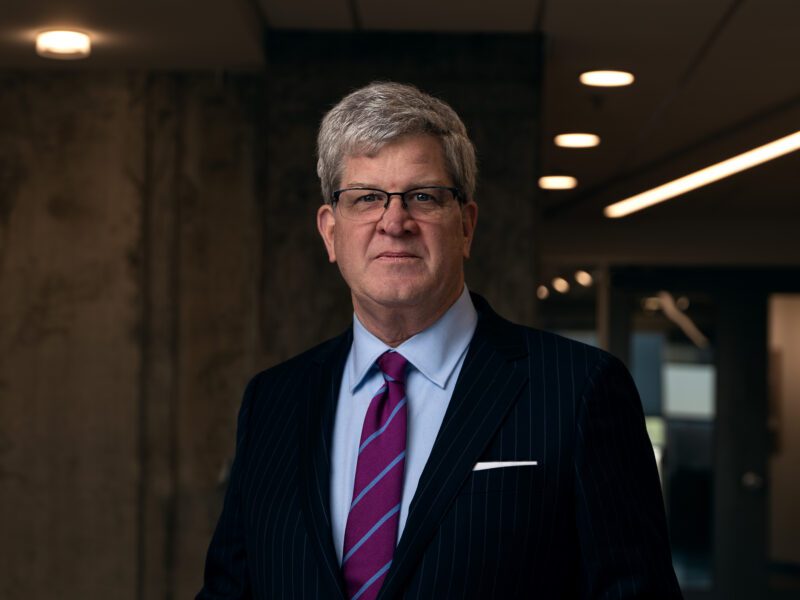
“When someone comes to me because they don’t know where else to turn, I want them to know one thing: Whatever comes next, they won’t have to face it by themselves.”

Received Martindale-Hubbell AV Preeminent Rating4
Named a “Super Lawyer”3 by Super Lawyers magazine, 2012, 2017 – 2020, and 2023 – 2024

Named to “Best Lawyers” list4 for Mass Tort Litigation – Plaintiffs, 2026-2027, and Personal Injury Litigation – Plaintiffs, 2024-2027, by Best Lawyers
Attorney Paul R. Dickinson, Jr. (Partner)
Paul Dickinson knows what it feels like when life does not go according to plan.
Long before becoming an accomplished trial attorney, Paul spent several years moving between school and work. He worked as a dishwasher. A construction worker. A landscaper. A lumberyard worker. A restaurant manager. He remembers having less than $20 to his name and not having enough money for groceries. And while working at a lumberyard, he suffered two serious workplace injuries – including one that required two surgeries and another that cost him part of a finger.
Today, Paul has been practicing law for more than 35 years. He has handled complex litigation, tried significant cases in state and federal courts, and represented people taking on powerful corporations and institutions. His work has earned him professional recognition from his colleagues and gratitude from his clients.
But the years before Paul became a lawyer still shape the way he practices law today.
Because when a client tells Paul they are injured, scared about paying their bills, worried about losing their job, or simply unsure what to do next, he can relate to that uncertainty. He may not have lived their exact story, but he understands what it feels like when the future you expected suddenly changes.
Knowing What It Means to Start Again
Paul’s path through college was anything but straightforward. He stepped away from school more than once while working a series of jobs and trying to figure out what direction he wanted his life to take.
Eventually, he decided it was time to start over, one class at a time.
When Paul returned to college, he initially took a single class and earned an A. The next semester, he took two. He then returned to school full-time while continuing to work and paying his own way. Paul eventually earned a finance degree from the University of South Florida, finishing with straight A’s his last semester – a far cry from his first college semester after high school. And Paul earned those straight A’s while working long hours at a restaurant.
That experience taught him something he carries with him today: Where you are right now does not have to determine where you end up.
A Secondhand Suit and One More Chance
Even after graduating, Paul’s future was far from settled.
He went to recruiting interviews wearing a gray pinstripe suit he had bought at Goodwill, hoping to enter the finance world. However, his college transcript still reflected those early semesters and the indirect path toward graduation.
Paul eventually found a job selling direct-mail advertising. On the very day he made his biggest sale, the company announced it was closing. He went back to the restaurant business and began wondering what came next.
Paul frequently crossed paths with former Florida Appellate Court Judge E.J. Salcines, who would tell him that he thought he would make a good lawyer. Salcines encouraged him to apply to South Texas College of Law in Houston, which was known for developing strong trial advocates.
Paul’s undergraduate record made admission difficult, and his path to law school was anything but assured. But once he was given the opportunity, he made the most of it. At South Texas, he discovered both a talent and a passion for advocacy.
What followed was the beginning of a career Paul never could have envisioned during those early years struggling to find his direction.
And when he tried his first case as a lawyer, he deliberately wore that same Goodwill suit.
Finding the Work He Was Meant to Do
During law school, Paul participated in mock trial competitions and found himself drawn to everything about litigation – the preparation, the pressure, examining witnesses, opening statements, and closing arguments. He won oral advocacy awards, was selected for a “Top Gun” advanced litigation course, and was invited to join his school’s national mock trial team.
After law school, Paul began his career representing insurance companies and businesses. Eventually, however, his career took him to the other side of the courtroom – representing injured people. He actively sought courtroom experience, working on complex trucking, product liability, personal injury, and wrongful death cases.
That change from representing insurance companies to representing victims proved important.
Paul had spent years learning how companies and insurers defend cases. But his own life had given him something equally valuable when he began representing injured people. He had worked manual-labor jobs. He had been seriously injured on the job himself. He had worried about money and experienced periods when there was little margin for anything to go wrong.
Those experiences did not make Paul’s story the same as his clients’. But they did give him a frame of reference that many lawyers simply do not have.
And he also understood how much it can matter to have somebody in your corner.
“They Need Answers. They Need Help. They Need Guidance.”
Ask Paul what matters most when he meets with someone who has been seriously injured, and his answer is not a courtroom strategy.
It is listening.
Paul has met clients who were struggling to pay their bills, had lost their jobs, or were unsure how they were going to provide for themselves or their families. Those conversations remind him of periods in his own life when money was scarce and stability was anything but guaranteed.
So, he listens carefully…and then he gets to work.
Standing Up to Powerful Entities
Paul’s belief in standing beside people who are taking on massive entities has taken him far beyond ordinary personal injury cases.
He represented six victims and families affected by the 2007 Nisour Square shooting in Baghdad involving Blackwater private military contractors.* His clients included the family of nine-year-old Ali Kinani, who was killed while riding in the back seat of his father’s vehicle. Paul pursued civil claims in North Carolina against Blackwater, its founder, and others responsible.
The case required years of complicated litigation involving clients thousands of miles away and extraordinary legal obstacles. Paul describes representing the victims and their families as an honor, and he recognizes the faith they placed in the American legal system. For Paul, the case reinforced something fundamental about the role of a lawyer: Sometimes the people facing the most powerful opponents are the ones who most need someone to stand beside them.
That principle applies just as strongly to the clients whose cases will never make headlines.
Paul does not measure the importance of a case solely by the size of its result.1 Some of the cases that have stayed with him longest involve everyday underdogs. A client who finally has enough to pay a debt. Someone who has spent months feeling ignored who finally knows that their voice was heard.
Trust Is Earned Every Day
When Paul first sits down with an injured client, he often gives them a simple assignment: Focus on getting better.
Paul and his team will focus on the legal case to take one source of uncertainty off their shoulders so they can put their energy toward moving forward. He also tells clients that they will never have to go anywhere, do anything, or say anything in their lawsuit without him being there with them, and together, they will prepare for each step.
Time Off
Paul and his wife live in Charlotte with their furry companions, Baxter and Daisy. They enjoy their time away from work traveling or relaxing on North Carolina’s Lake James.
Read and Hear More
- 31 James Scott Farrin Attorneys Named to 2027 "Best Lawyers in America" Lists4
- Attorney Paul R. Dickinson, Jr. Recognized as an 'Icon'
- 33 James Scott Farrin Attorneys Recognized by "Best Lawyers in America" in 2026 Edition4
- The Charlotte Observer: “CMPD briefing video on fatal rush hour police chase left out critical details”
- WBTV: ‘It was avoidable’: Attorney representing Charlotte woman killed in 2022 wrong way crash
- WCNC: CMPD ignores supervisor's orders before fatal crash, bodycam footage shows
- WSOCTV: CMPD releases video of pursuit before deadly crash in 2022
- 22 James Scott Farrin Attorneys Recognized by "Best Lawyers in America" on 2025 'Best Lawyers' and 'Ones to Watch' Lists4
- The News & Observer: NC lawyer: Our laws on police chases aren’t tough enough. People are dying.
- 29 James Scott Farrin Attorneys Recognized by "Best Lawyers in America" on 2024 'Best Lawyers' and 'Ones to Watch' Lists4
- Four James Scott Farrin Attorneys Named by "Super Lawyers" to 2024 North Carolina 'Super Lawyers' list4
- WBTV: Investigation continues after crash involving Hickory police kills mom, 12-year-old son
- WBTV: Next steps for Charlotteans impacted by 5-alarm fire in South Park area
- ABC45 News: Atrium Health Wake Forest Baptist reviewing breast cancer lab procedures
- Three New Partners Join Leadership Ranks of James Scott Farrin
- Five James Scott Farrin Attorneys Recognized on “Super Lawyers” 2023 North Carolina ‘Super Lawyers’ and ‘Rising Stars’ Lists4
- James Scott Farrin Named to "U.S. News - Best Lawyers" 2023 'Best Law Firms' List, 8th Straight Year4
- WSOC-TV: Balancing the benefit of chasing suspect, public safety
- The Pete Kaliner Show Podcast: After 2-hour pursuit in Charlotte, police policy gets scrutiny
- Three James Scott Farrin Attorneys Named to 2020 'North Carolina Super Lawyers' List3
- MSNBC All In with Chris Hayes: Trump pardoned four ex-Blackwater guards. Here’s the story of their victims.
- USA Today: 'Egregious and disgusting': Trump's pardon of Blackwater contractors sparks outrage, warnings
- NPR: Shock And Dismay After Trump Pardons Blackwater Guards Who Killed 14 Iraqi Civilians
- PBS News Hour: How the Blackwater pardons could have a lasting impact: ‘The Americans got away with it’
- The New York Times: Trump's Most Disgusting Pardons
- Newsweek: 'Trump Has Pardoned a Child Murderer' Says Lawyer for Iraq Blackwater Massacre Victims
Licensed In
- North Carolina
Practice Area
- Business Litigation
- Car Accidents
- Class Actions
- Construction Litigation
- Medical Malpractice
- Medical Negligence
- Motorcycle Accidents
- Nursing Home Negligence
- Personal Injury
- Product Liability
- Whistleblower Claims
- Employment Law
Honors/Awards/
Accomplishments
- “Legal 250” list4 by North Carolina Lawyers Weekly, 2026
- “Icon” list4 by North Carolina Lawyers Weekly, 2026
- “Best Lawyers” list4 for Mass Tort Litigation – Plaintiffs, 2026 – 2027 by Best Lawyers in America
- “Best Lawyers” list4 for Personal Injury Litigation – Plaintiffs, 2024 – 2027 by Best Lawyers in America
- “Super Lawyers”4 by Super Lawyers magazine, 2012, 2017 – 2020, and 2023 – 2024
- Martindale-Hubbell AV Preeminent Rating4

Memberships
- North Carolina Bar Association
- North Carolina Advocates for Justice
- American Association for Justice
Classes & Seminars
- Personal Injury Evidence: Social Media, Smartphones, Experts and Medical Records, National Business Institute, 2018
- Truck Accident Litigation From A to Z, National Business Institute, 2015
- Advanced Trial Tactics, National Business Institute, 2013
- Evidence and Admissibility: Practical Tips for Trial, National Business Institute, 2012
- Applying the Rules of Evidence: What Every Attorney Needs to Know, National Business Institute, 2011 – 2012
- Litigating to Win Through Advanced Trial Advocacy, National Business Institute, 2008
- Evidence and Expert Testimony Best Practices: Supporting Your Case, National Business Institute, 2007
- Toxic Mold & Construction Defects in Common Ownership Properties, Communities Association Institute, 2004
- What You Really Need to Know About Mold and Your Legal Liabilities in North Carolina, National Business Institute, 2003 – 2004
- Analyzing and Proving Construction Project Damages, Lorman Education Services, 2002
- Controlling Complex Civil Litigation, Mecklenburg County Paralegal Society, 1998
- Fibromyalgia: Cross Examining the Expert Witness, NCADA CLE Seminar, 1996
Publications & Speaking Engagements
- “NC lawyer: Our laws on police chases aren’t tough enough. People are dying.” The Charlotte Observer, 2024
- “Expert Evidence – A Judicial Diagnosis,” The Icfai University Press, Chapter: Evidence and Expert Testimony, 2008
Law School
South Texas College of Law
Houston, TX
1990, J.D.
College
University of South Florida
Tampa, FL
1986, B.A. in Finance
 Former Auto Accident Client, Online Google Review
Former Car Accident Client, Online Google Review
Former Auto Accident Client, Online Google Review
Former Car Accident Client, Online Google Review
For legal reasons and client confidentiality, reviews have been slightly edited to remove identifying information and correct typos.
*Case handled prior to joining James Scott Farrin.