


Ready to settle your workers’ comp case?

Don’t settle for less. Here’s what you need to now and how an attorney can increase your odds of maximum compensation.

This page refers to Workers’ Comp law in North Carolina.
Since laws differ between states, if you are located in South Carolina, please click here.
Note: This page includes helpful information for injured workers who have received medical and lost wage benefits after being injured at work and are ready to settle or close their workers’ compensation case. If you have recently been injured at work and are interested in learning how to try to ensure that you receive the full workers’ compensation benefits to which you may be entitled, please read the blog .
How Are Workers’ Compensation Settlements Calculated in North Carolina?
A North Carolina workers’ compensation settlement may be calculated by estimating the value of your unpaid wage benefits, permanent disability, future medical care, and other injury-related needs. The potential calculation depends on your average weekly wage, ability to return to work, impairment rating, work restrictions, expected treatment, and the type of settlement that may be offered.
There is no single formula that determines the value of every North Carolina workers’ compensation settlement. A Form 26A payment may be based primarily on an impairment rating, while a full and final clincher agreement may account for future wage loss, medical expenses, permanent restrictions, and other costs associated with the injury.
Before you close your workers’ comp claim and accept a potential settlement from the insurance company, consult with an experienced workers’ compensation attorney who has your best interests and needs in mind. An early settlement offer may be the way some insurance companies try paying you less.
For help in determining if you are eligible for a settlement and how much your settlement may really be worth, call 1-866-900-7078 today for a free case evaluation.

How Is a North Carolina Workers’ Comp Settlement Calculated?
There is no single formula for calculating a North Carolina workers’ comp settlement. The potential value is based on the disability compensation and medical benefits at stake, along with factors specific to the injured worker and the claim.
Two main categories are typically evaluated in workers’ compensation settlements:
- Disability compensation: This can include unpaid wage benefits, future wage-loss benefits, and compensation for permanent impairment.
- Medical benefits: This can include anticipated treatment, medication, medical equipment, home modifications, attendant care, and other injury-related medical needs.
The value of these benefits is considered together and can be affected by the type of potential settlement, the strength of the claim, the worker’s ability to earn wages in the future, and the benefits or rights the worker gives up by settling.
What Can Be Included in a Workers’ Comp Settlement?
- Past-due wage replacement benefits
- Future disability or wage-loss benefits
- Permanent impairment compensation
- Future medical treatment and medication
- Vocational limitations and reduced earning capacity
- Medical equipment, home modifications, or attendant care
- Medicare, Medicaid, or other applicable liens
What Factors Determine a Workers’ Comp Settlement Amount in North Carolina?
The value of a North Carolina workers’ compensation settlement depends on the benefits that may still be owed and the future costs or rights being resolved. Important factors may include:
Wage and disability factors:
- The average weekly wage and workers’ compensation rate
- Unpaid temporary disability benefits
- Whether you can return to your former job
- Permanent work restrictions
- Reduced earning capacity and future job prospects
- Your permanent impairment rating
Medical and long-term care factors:
- Unpaid medical bills
- Expected future treatment, surgery, medication, and rehabilitation
- In-home or attendant care
- Durable medical equipment and home modifications
- Medicare Set-Aside requirements
- Medicare, Medicaid, or other applicable liens
Generally, it is recommended to wait until your doctor determines that you have reached Maximum Medical Improvement (MMI) before accepting any settlement offer.
Note: Workers’ compensation benefits and settlements do not include compensation for pain and suffering.
How Are Weekly Workers’ Comp Benefits Calculated?
In North Carolina, weekly workers’ compensation disability benefits are generally based on the injured worker’s average weekly wage (AWW). For total disability, the weekly compensation rate is generally 66⅔% of the worker’s average weekly wage, subject to the minimum and maximum rates that apply under North Carolina law.*
For example, if your average weekly wage before your injury was $900, your weekly compensation rate would generally be $600:
$900 × 66⅔% = $600 per week
*For partial disability, North Carolina generally calculates the benefit as 66⅔% of the difference between pre-injury AWW and what the worker is able to earn afterward.
For injuries occurring in 2026, the maximum weekly workers’ compensation benefit is $1,446. The minimum is generally $30 per week for injuries occurring before July 1, 2027. After this date, the minimum will rise to $50 per week.
This weekly compensation rate can become an important building block when evaluating a potential workers’ comp settlement. It may be used to calculate unpaid disability benefits, future wage-loss benefits, and compensation for permanent partial disability.
How Is an Impairment Rating Payment Calculated?
In North Carolina, compensation for a permanent impairment is calculated using three numbers: the impairment rating, the number of weeks assigned by law to the injured body part, and the worker’s weekly compensation rate.
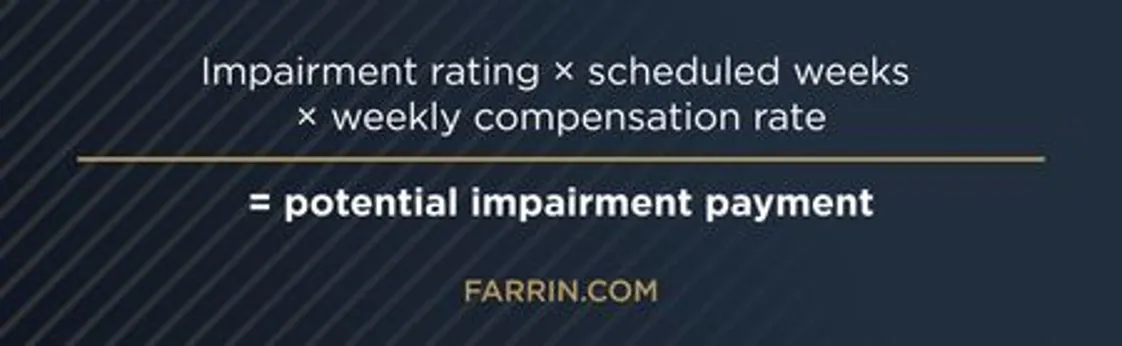
North Carolina law assigns a specific number of weeks to different body parts (for example, an arm is assigned 240 weeks, and a leg is assigned 200 weeks.)
For example: consider a worker with a 25% impairment rating to the arm and a $600 weekly compensation rate:
25% × 240 weeks × $600 = $36,000
The above formula calculates the potential payment for permanent impairment under the statutory schedule. It does not determine the potential value of a full negotiated workers’ comp settlement, which may involve additional benefits, risks, and rights.
Example of a North Carolina Workers’ Comp Calculation
Here is an example of how permanent impairment compensation may be calculated for an injured North Carolina worker with an average weekly wage of $900 and a 25% permanent impairment rating to an arm.
Step 1: Calculate the weekly compensation rate.
The worker’s $900 average weekly wage is multiplied by 66⅔%, resulting in a weekly compensation rate of $600:
$900 AWW × 66⅔% = $600 weekly compensation
Step 2: Calculate the compensable weeks.
North Carolina law assigns 240 weeks to the loss of an arm. A 25% impairment rating would therefore equal 60 compensable weeks:
240 weeks × 25% = 60 weeks
Step 3: Calculate the potential impairment payment.
The 60 compensable weeks are multiplied by the $600 weekly compensation rate:
60 weeks × $600 = $36,000 impairment payment
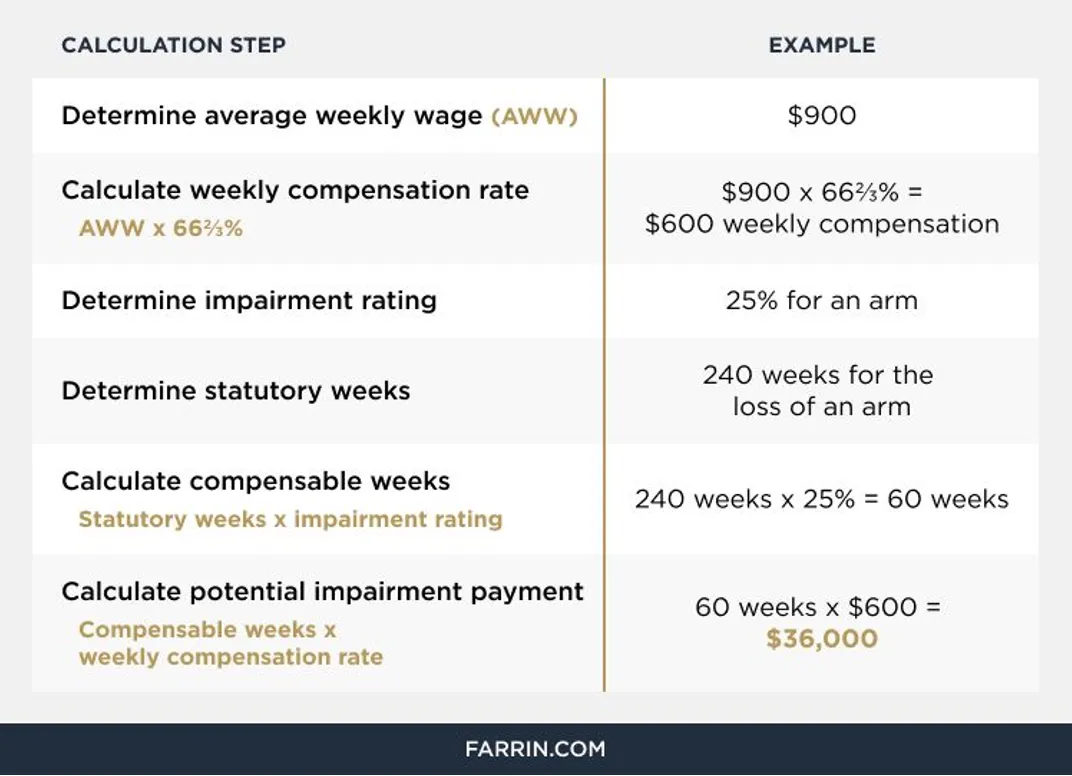
In this example, the potential impairment payment is $36,000. This calculation reflects the permanent impairment portion only and should not be viewed as an estimate of the worker’s total settlement value. A negotiated clincher settlement could be higher or lower after considering future medical care, work restrictions, future wage loss, disputed issues, and the rights the worker gives up as part of the settlement.
Does Workers’ Comp Always Offer a Settlement?
No. If you recover fully from your on-the-job accident and are able to return to your previous position with no long-term consequences, workers’ comp may not offer you a settlement.
However, if you have permanent effects from your injury, need continued medical care, or have unpaid workers’ comp benefits or medical bills, you may need to explore a possible workers’ comp settlement.

In North Carolina, workers’ compensation settlements are voluntary. You do not have to settle your case, no matter what some insurance companies or employers may tell you. If you are approved, you may be able to receive workers’ comp benefits for lost wages and medical care until you reach the maximum number of weeks allowed under law, which may vary by injury.
And, if you are severely and permanently disabled and require continuing medical treatment, your workers’ comp attorney may advise you to let your employer or their insurance company pay potential lifetime wage replacement and medical benefits instead of settling.
Other times, it can be in your best interest to figure out a potential workers’ comp settlement and not have to deal with the insurance company again. An experienced workers’ comp lawyer can help you weigh your options and decide on the best path forward for you.
To get clarity on your case at no cost and no obligation, call 1-866-900-7078 today.
When Will Workers’ Comp Offer a Settlement?
Possible workers’ comp settlements are usually not negotiated until your medical treatment is completed and your doctor releases you from treatment. This is called reaching maximum medical improvement, or MMI for short.
At MMI, the doctor will decide whether you:
- have any permanent impairments
- have any permanent physical work restrictions
- may need additional medical treatment in the future
These are some of the important factors that go into determining how much your potential settlement may be worth.
Note: You may not be entitled to any additional benefits if you have received medical and lost wage benefits, recovered, and returned to work. In these cases, no settlement may be offered. If instead, you have future financial or medical needs because of your work injury, consult with an experienced workers’ comp attorney to figure out a potential workers’ comp settlement amount.
Should I Accept the Workers’ Comp Settlement Offer?
You should consider accepting a workers’ comp settlement offer if you have consulted with an experienced workers’ compensation attorney about your case and have negotiated a reasonable potential settlement with their help. It is usually not recommended to accept the insurance company’s first potential settlement offer. While negotiating a settlement may take longer, it can also result in a better settlement.
What Types of Workers’ Comp Settlements Are Available in North Carolina?
In North Carolina, workers’ compensation settlements are generally structured as clincher agreements or as Form 26A settlements.
- A clincher agreement, also called a compromise settlement agreement, is generally a full and final resolution of the claim. Its value may be negotiated based on future wage benefits, medical care, permanent restrictions, impairment, earning capacity, and other unresolved exposure. In exchange for the settlement, the worker generally gives up the right to seek additional wage-loss benefits or injury-related medical treatment.
- A Form 26A agreement provides compensation based on a permanent impairment rating. The amount is generally tied to the impairment percentage, the statutory number of weeks assigned to the injured body part, and the worker’s weekly compensation rate. A Form 26A payment is not the same as a full and final clincher settlement and does not automatically represent the claim’s total potential value.
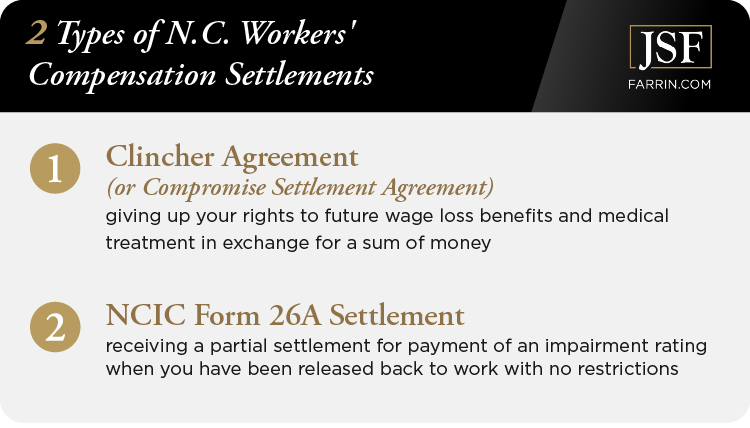
An experienced workers’ compensation attorney can advise you on whether accepting a potential clincher agreement or a Form 26A settlement makes sense for you, and if so, can help you pursue the highest possible settlement amount.
How Settlements Are Paid – Lump Sum or Structured
If you accept a potential settlement offer, you and your attorney can determine how you want it paid to you. Settlement payments may come in two forms:
- Lump sum: you receive the total settlement amount in a single payment. The majority of clincher agreements are paid as lump sum amounts.
- Structured: your possible settlement is paid to you in installments over an extended period. Your lawyer may advise you to consider a structured settlement if your work injury or illness left you totally disabled and in need of long-term care.
How Does the Insurance Company Calculate a Settlement Offer?
An insurance company may estimate what it expects to pay if the claim remains open, including future wage benefits, medical treatment, and administrative or litigation costs. It may then offer a discounted amount in exchange for closing some or all of the claim. That initial offer may not account fully for disputed benefits, reduced earning capacity, future treatment, or the long-term consequences of permanent restrictions.
After you reach Maximum Medical Improvement (MMI) in North Carolina, settlement negotiations may occur at a mediation, which is also known as a settlement conference. A large majority of workers’ compensation cases heading toward a settlement settle at mediation, so it is beneficial to have an experienced workers’ comp lawyer by your side to help you fight for a maximum settlement amount.

How Future Wage Loss and Medical Costs Affect a Settlement
Future wage-loss calculations may begin with the worker’s compensation rate, which is generally based on 66 2/3% of the average weekly wage. Settlement negotiations may consider how long those benefits could continue, whether the worker can return to suitable employment, and whether permanent restrictions will reduce future earning capacity.
Future medical costs may be estimated using treatment recommendations, expected procedures, medication, rehabilitation, medical equipment, and long-term care needs.
Workers’ Comp vs. Personal Injury Clarification
A North Carolina workers’ compensation settlement is not calculated the same way as a personal injury settlement and does not include separate damages for pain and suffering. Instead, the settlement reflects workers’ comp benefits at issue, such as disability compensation and medical benefits, as well as future medical exposure and the rights being resolved through the potential settlement.
When Can I Expect to Receive a Payout?
Since there are several parties and steps involved in negotiating and approving any settlement agreement, the waiting time for a potential payout will vary for each case. If the terms of your potential workers’ compensation settlement are negotiated between you and your employer or their insurance company, the settlement agreement must still be approved by the North Carolina Industrial Commission (NCIC).
You can receive a payout for your potential settlement if the North Carolina Industrial Commission (NCIC) approves the settlement agreement.

For clincher agreements, once the NCIC approves any settlement agreement, payment must be sent within 24 days of approval.
For Form 26A agreements, you can potentially receive the value of any permanent disability rating in weekly installments that could start as of the day you reach Maximum Medical Improvement.
How Long Do Most Workers’ Comp Settlements Take?
There is no definite timeline. Typically, possible settlement discussions don’t start until after your medical treatment concludes. After that, it could take anywhere from 4-6 months to come to agreement on a potential settlement, but every workers’ comp claim is different.
Accepting the insurance company’s first potential settlement offer, while it may be quicker, is rarely recommended, and taking the time to negotiate for a fair settlement can pay off in terms of your possible compensation.
What Is the Process After My Claim Is Settled?
The process if your claim is settled depends on the type of potential settlement.
- If you agree to a clincher agreement, your workers’ comp claim case is officially closed, and you will receive the amount agreed upon. Clincher agreements also usually require that you resign from the company and agree not to reapply for a position with the company in the future. Therefore, if signing a clincher agreement, you are usually walking away from your job and the medical care that was provided by workers’ comp.
- If you agree to a Form26A agreement, you will receive the value of your impairment rating, and you can request to receive medical benefits for two years after any impairment rating is paid.
James Scott Farrin Has a Formidable N.C. Workers’ Comp Team
Many of our workers’ comp attorneys are N.C. State Bar Board Certified Specialists in workers’ compensation law. This is the highest level of specialization available in N.C., and only a small percentage (less than 1%) of attorneys licensed to practice in the state have earned this recognition for workers’ compensation.*
On our team, we also have former Deputy Commissioners for the North Carolina Industrial Commission (the agency in charge of workers’ comp in N.C.). And 11 of our attorneys were honored on the Best Lawyers 2027 “Best Lawyers” list for workers’ compensation.4
There’s no need to worry about the cost of having our experienced team in your corner. There are no hourly fees, no upfront costs – and you don’t pay a fee at all if we don’t get compensation for you. Guaranteed.2
Whether you are at the beginning of your workers’ comp claim or hoping to settle it, our attorneys can help. It’s our policy to always put you first, and we will be by your side as we seek to get you everything you deserve.
You are not alone. Call us today for a free case evaluation at 1-866-900-7078.
*Figures provided by NC State Bar as of 1/26.