

I visit parking lots almost every single day, just like everyone else — whether I’m grabbing groceries or heading to the State Farmers Market here in Raleigh. We all expect these spaces to be reasonably safe, but as a lawyer, I see the unfortunate reality that often lies behind that assumption. In my practice, I frequently handle cases where a routine stop turned into a serious medical emergency.
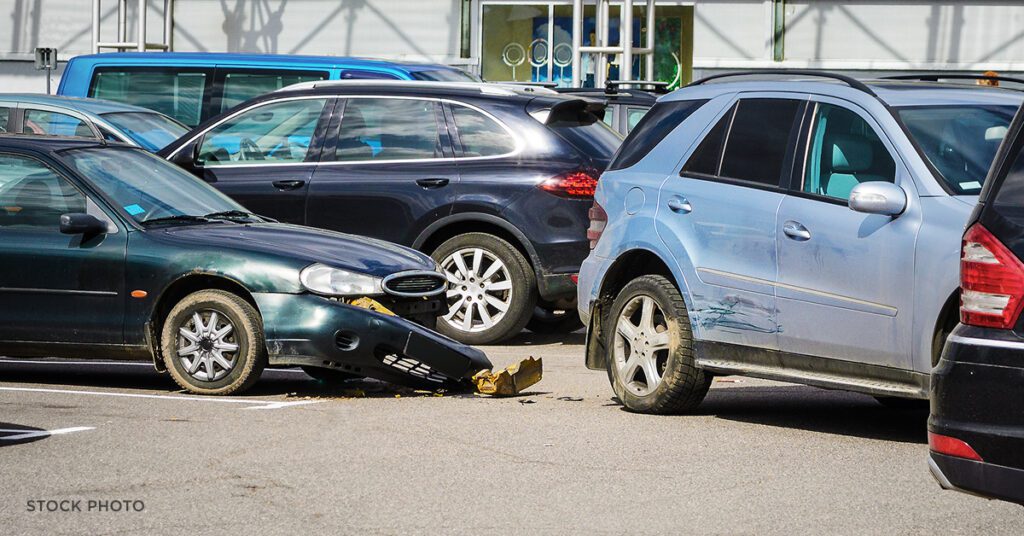
One thing I often explain to clients is that parking lot accidents are deceptively complex. Unlike a crash on a public highway or a city street, the rules here aren’t always cut and dry, and police officers often view them differently than standard traffic collisions. While the low speeds might create a false sense of security, the mix of pedestrians and reversing vehicles creates a dangerous environment.
Determining fault is the cornerstone of the cases I build to try to recover medical bills and lost wages, and that often means I have to look beyond just the other driver to investigate whether the property owner failed in their duty to keep you safe.
Key Takeaways About Liability in Parking Lot Accidents
- Determining who is at-fault in a parking lot accident involves analyzing right-of-way rules, even on private property.
- Drivers in main thoroughfare lanes generally have the right-of-way over those in feeder lanes or pulling out of parking spots.
- Property owners might share responsibility if their negligence, such as poor maintenance or inadequate lighting, contributed to the accident.
- Evidence like photos, witness statements, and incident reports is vital for establishing who may be responsible.
- An attorney can investigate contributing factors and seek out all potential sources of compensation for an injury claim.
Common Types of Parking Lot Accidents
In my years of helping people injured in accidents, I’ve seen how a simple trip to the store can change in an instant. Parking lot accidents come in many forms, each with its own challenges when trying to figure out who was at fault.
Some of the most frequent scenarios I see include:
- Two cars backing into each other: This is a classic “he said, she said” situation. Fault can be shared, or one driver might be held primarily responsible if they began backing out first and the other failed to see them.
- A car backing out of a space into traffic: The driver in the main traffic lane typically has the right-of-way. The person pulling out of the space has a duty to wait until it is clear to do so.
- Two cars competing for the same parking spot: A crash can happen when two drivers head for the same empty space. Often, the driver who was there first or who was making a left turn into the space might be considered at fault for not yielding to the driver turning right.
- Rear-end collisions at stop signs: Stop signs and other traffic signs within a parking lot are often enforceable. A driver who fails to stop and hits another vehicle is generally seen as negligent.
- Accidents involving pedestrians: Pedestrians are particularly vulnerable in parking lots. Drivers have a duty to be aware of their surroundings, but complex cases can arise depending on where the pedestrian was walking.
Pinpointing possible legal responsibility requires a deeper look into the specific rules that apply in these environments.
Who Is At-Fault in a Parking Lot Accident?
Figuring out who is legally responsible for your injuries after a parking lot crash isn’t as simple as it can be on a public road. While traffic laws might not all apply directly on private property, the core principles of negligence do. Negligence is a legal term that essentially means someone acted carelessly, and their carelessness caused harm to someone else.
An insurance company will try to determine which party was negligent when they evaluate a claim.
The Driver With the Right-of-Way
Even without official traffic signals, parking lots generally have an understood traffic flow. Think of it like a river system. The main lanes that circle the lot or lead to the exits are the main thoroughfares. The smaller lanes with the parking spaces are called feeder lanes.
- General Rule: A driver in the main thoroughfare has the right-of-way over a driver in a feeder lane.
- Pulling Out: A driver pulling out of a parking space must yield to traffic in both the feeder lane and the main thoroughfare.
The driver who fails to yield the right-of-way is often found to be the one at fault. For example, if you are driving down a main lane and someone pulls out directly in front of you from a parking space, that driver is likely to be considered responsible for the collision.
Following the Rules of the Road
While a police officer might not issue a ticket for running a stop sign in a private lot, that sign may still be used to help establish fault. The same goes for painted lines, directional arrows, and speed limit signs posted by the property owner.
A reasonable driver is expected to follow these posted rules. When someone ignores a stop sign and causes an accident, their decision to ignore the sign can be powerful evidence of their possible carelessness. This is a key part of the “three-legged stool” concept we often use to explain negligence: the at-fault party had a duty to act safely, they breached that duty, and that breach caused the injury.
Can a Property Owner Be Held Responsible for Your Injuries?
Sometimes, the fault for a parking lot accident goes beyond the drivers involved. Property owners have a legal duty to maintain their premises in a reasonably safe condition for customers and visitors.
This legal concept is known as premises liability. If a property owner fails in this duty and their failure contributes to your injury, they might be held partially or fully responsible.
Premises Liability in Carolina Parking Lots
The law requires property owners to correct or warn visitors about dangerous conditions they know about or should reasonably know about. For example, the owner of a busy Greenville, SC or Charlotte, NC shopping center has a responsibility to ensure the parking lot is reasonably safe for shoppers. This duty can be quite broad and applies to many different hazards.
Examples of Property Owner Negligence in Parking Lot Accidents
A property owner’s carelessness can manifest itself in many ways. If your accident was caused or made worse by a hazardous condition in the lot, the owner or management company could be a party in your injury claim.
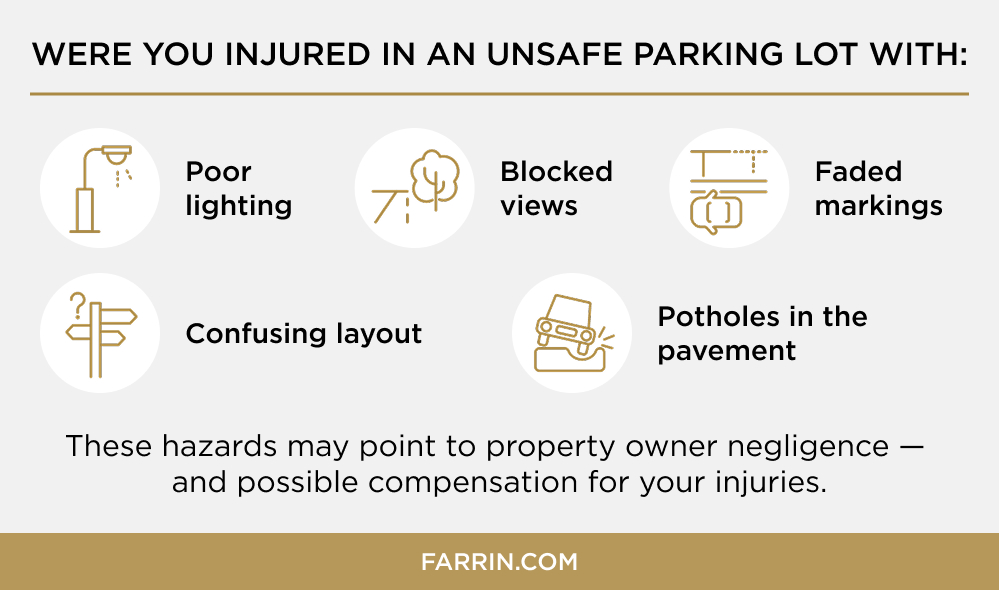
Here are some potential hazards that could point to property owner negligence:
- Poor Lighting: Inadequate lighting at night can make it difficult for drivers to see pedestrians or other vehicles, increasing the risk of an accident.
- Large Potholes or Cracks: A driver swerving to avoid a massive pothole could collide with another car. Unrepaired pavement can also cause a pedestrian to trip and fall, potentially into the path of a vehicle.
- Faded Pavement Markings: If stop lines, crosswalks, or directional arrows are so faded that they are not visible, it can create confusion and lead to collisions.
- Poorly Designed Traffic Flow: Confusing layouts, blind corners, or a lack of proper signage can create inherently dangerous situations for which the owner might be responsible.
- Obstructed Views: Hedges, trees, or garbage bins that block a driver’s view at an intersection within the lot can contribute to an accident.
Proving that a property owner was negligent requires showing they knew or should have known about the danger and did not take reasonable steps to fix it. This often requires a thorough investigation, which is something an experienced attorney can handle.
What to Do After a Parking Lot Accident
After any accident, the first priority is your health. Once you have received medical attention, it’s time to focus on protecting your rights and gathering information for a potential injury claim. The actions you take in the days following the incident can be very important.
Document Everything You Can
Evidence is the cornerstone of any personal injury case. Memories can fade over time, so it’s a good idea to document as much as possible, as soon as possible.
- Take Photos: If you were able, hopefully you took pictures of the vehicles and the accident scene. If not, you might be able to go back to the location and take pictures of the general layout, any relevant signs, and any property damage that still exists.
- Write It Down: Create a detailed written account of what happened while it’s still fresh in your mind. Note the date, time, weather conditions, and exactly how the accident occurred from your perspective.
- Get Witness Information: If anyone saw the accident, their testimony could be crucial. If you have their contact information, keep it in a safe place.
Report the Incident
Even though it’s on private property, it is often wise to report the accident. A police report creates an official record of the event. Under North Carolina General Statute § 20-166.1 and South Carolina Code § 56-5-1270, a crash resulting in injury, death, or significant property damage must be reported.
You should also file an incident report with the business or property owner where the accident took place. This report creates a record that the owner was made aware of the incident and the conditions in their lot at that time. This can be important evidence later, especially if you believe an unsafe condition contributed to the crash.
How an Attorney Can Help Determine Who Is Responsible
When you are trying to recover from an injury, the last thing you want is a fight with an insurance company. Unfortunately, insurance adjusters often look for any reason to pay out less on a claim.
- In North Carolina, insurance companies can use the state’s contributory negligence laws to try to avoid paying anything at all if you are determined to be just 1% negligent.
- In South Carolina, a comparative negligence state, you can still potentially recover compensation even if you are partially at fault (as long as your fault is not 51% or greater).
This is where having a dedicated advocate on your side can make a significant difference. A personal injury attorney’s job is to build your case and fight for the compensation you might be owed.
Investigating All the Details
A personal injury attorney can launch a comprehensive investigation to try to gather the evidence needed to prove who was responsible. This can go far beyond what you are able to do on your own.
An investigation might include:
- Obtaining surveillance footage: Many parking lots have security cameras. This video evidence can be invaluable in showing exactly how an accident happened. We can send a formal request to the property owner to preserve this footage before they delete it.
- Interviewing witnesses: We can contact anyone who saw the accident to seek their formal statements about what they observed.
- Hiring experts if needed: In complex cases, we might work with accident reconstruction experts to analyze the crash and provide a professional opinion on how it occurred and who was at fault.
Detailed investigation allows us to build a compelling case on your behalf and counter the insurance company’s tactics. We handle the insurance company for you so you can focus on what matters most — getting better.
FAQs for Parking Lot Accidents and Liability in North and South Carolina
Here are some answers to common questions I hear from people across the Carolinas who have been injured in a parking lot accident.
 Text Us