

If you’ve been hurt on the job in North Carolina, your mind is likely racing with questions. How will I pay my bills? When can I go back to work? What happens if my injury is serious?

As an attorney who helps injured people, I understand these concerns. One of the most common points of confusion I see revolves around workers’ compensation payments. Many people aren’t aware that the system potentially provides different types of wage replacement benefits depending on the stage and severity of their injury — temporary and permanent disability benefits. These benefits can provide a financial bridge while you heal and compensate you for any long-lasting effects of your injury.
The transition from one type to another, however, can be a pivotal moment in your case, and it’s important to have a grasp on what each one may mean for you and your family.
Key Takeaways About Temporary vs. Permanent Disability Benefits in North Carolina
- Temporary disability benefits are paid while an eligible injured employee is actively recovering and unable to perform their regular job duties.
- Permanent disability benefits are considered once a doctor determines the employee has reached Maximum Medical Improvement (MMI).
- Maximum Medical Improvement means the medical condition has stabilized, not that the person is fully healed.
- Potential benefits are generally calculated as two-thirds of the employee’s average weekly wage, up to a state-mandated maximum.
- The type of benefit an injured worker might receive can change from temporary to permanent based on medical evaluations and impairment ratings.
The Foundation of NC Workers’ Comp Disability Benefits
The North Carolina workers’ compensation system was created to provide a structured way for most injured employees to receive medical care and wage replacement benefits, generally regardless of who was at fault for the on-the-job injury. When a workplace accident leaves you unable to earn your usual income, potential disability benefits are the part of the system that can help you stay financially afloat.
The primary goal of these possible benefits is to replace a portion of the wages you may have lost because of your injury. There are four main types of disability benefits in North Carolina, which fall under two broad categories: temporary and permanent.
- Temporary Total Disability (TTD): When your doctor says you cannot work at all for a period of time
- Temporary Partial Disability (TPD): When you can return to some form of work, but you earn less than you did before your injury
- Permanent Partial Disability (PPD): When your injury results in the permanent loss of function of a body part but you can still work in some capacity
- Permanent Total Disability (PTD): When your injury is so severe that it prevents you from returning to any meaningful employment

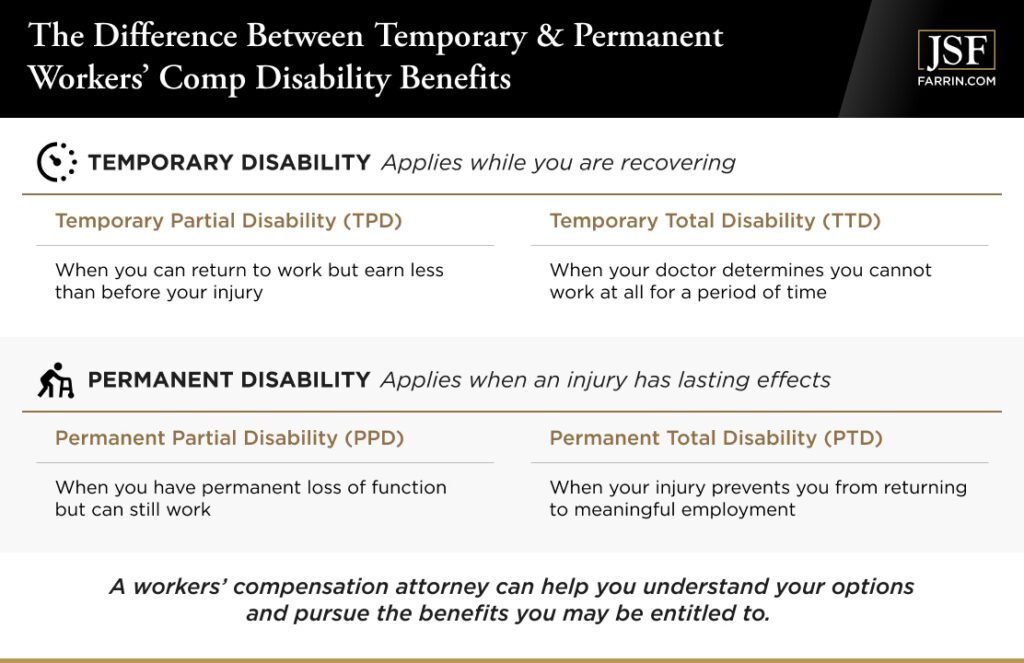
Each of these potential benefit types serves a different purpose and is governed by specific rules set forth in the North Carolina Workers’ Compensation Act. Let’s break them down further.
A Closer Look at Temporary Disability Benefits
As the name suggests, temporary disability benefits may be paid while you are temporarily out of work or on restricted duty during your healing process. These benefits can last from the time you become disabled by your injury until your doctor says you have recovered as much as you are going to.
Temporary Total Disability (TTD) Benefits
If your authorized treating physician has determined that you are completely unable to work because of your on-the-job injury, you may be eligible for Temporary Total Disability (TTD) benefits. These are the most common types of workers’ comp payments people may receive right after an injury.
In North Carolina, TTD benefits are calculated as two-thirds (66 2/3%) of the worker’s Average Weekly Wage (AWW). Your AWW is typically based on your earnings for the 52 weeks prior to your injury. There is a maximum weekly amount set by the state, which changes each year, so any benefit cannot exceed that cap. You can generally continue to receive these weekly checks until a doctor releases you to return to work in some capacity.
Temporary Partial Disability (TPD) Benefits
Sometimes, an injury doesn’t keep you out of work completely. Your doctor may release you to return to work with certain restrictions, often called “light duty.” If your employer can accommodate these restrictions, but you earn less money than you did before you were hurt, you might receive Temporary Partial Disability (TPD) benefits.
TPD can make up for some of the difference in your earnings. The potential benefit is calculated as two-thirds of the difference between your pre-injury AWW and what you are able to earn now. For example, if you used to earn $900 per week and now you can only earn $500 per week on light duty, the difference is $400. Any TPD benefit would be two-thirds of that, or approximately $266.67 per week.
Some situations where TPD benefits may apply include:
- Your doctor limits you to working four hours a day instead of eight
- You cannot perform certain tasks, so your employer moves you to a lower-paying position
- Your restrictions prevent you from earning overtime pay that was a regular part of your income
These benefits are also temporary and can help while you are still recovering and working toward your maximum level of healing.
The Critical Turning Point: Reaching Maximum Medical Improvement (MMI)
The transition from temporary to permanent disability benefits hinges on a single, crucial concept: Maximum Medical Improvement (MMI). I cannot stress enough how important this milestone is in a workers’ compensation case.
MMI is the point at which your treating physician determines that your medical condition has stabilized and is unlikely to improve any further, with or without additional medical treatment. It is critical to understand that MMI does not mean you are 100% cured or back to the way you were before the injury. It simply means you have reached a plateau in your recovery. You may still have pain, physical limitations, and may require ongoing medical care for the rest of your life.
Once you reach MMI, a few things typically happen:
- End of Temporary Benefits: Your eligibility for Temporary Total Disability (TTD) benefits often ends.
- Evaluation for Permanent Impairment: Your doctor will evaluate you to determine if you have any permanent impairment as a result of the injury.
- The Start of Permanent Benefits: If you do have a permanent impairment, this is when you could begin the process of receiving permanent disability benefits.
Some insurance companies may be eager to have a doctor declare a patient has reached MMI because it can reduce the amount they have to pay. This is one of many points in a case where having professional guidance can be extremely valuable.
Understanding Permanent Disability Benefits in NC
When your work injury leaves you with lasting consequences, the workers’ compensation system generally provides for permanent disability benefits. These benefits can compensate you for any permanent loss of function or long-term impact on your ability to earn a living.
Permanent Partial Disability (PPD) Benefits and Impairment Ratings
The most common form of permanent disability is Permanent Partial Disability (PPD). This applies when you have a permanent impairment to a part of your body, but you are still able to work in some capacity.
Once you reach Maximum Medical Improvement (MMI), your doctor may assign you a permanent impairment rating. This is a percentage that can represent the degree of function you have permanently lost in the injured body part. For example, a doctor may determine that your back injury resulted in a 10% permanent partial impairment to your spine.
North Carolina law has a “schedule” that assigns a specific number of weeks of compensation for different body parts. For example, under the statute, the loss of an arm is assigned 240 weeks, while the loss of a foot is assigned 144 weeks.
To calculate your potential PPD benefit, you multiply your weekly compensation rate (two-thirds of your AWW) by the number of weeks that may have been assigned to the body part, and then multiply that by your potential impairment rating percentage.
Let’s look at a simplified example:
- Your Average Weekly Wage was $900, so your compensation rate is $600
- You injured your arm, and the doctor assigns a 15% impairment rating
- The schedule allows 240 weeks for the loss of an arm
- The calculation in this example would be: $600 (compensation rate) x 240 (weeks for arm) x 15% (impairment rating) = $21,600
This amount can be paid out to you in weekly installments or sometimes as a lump sum in a settlement. An injured worker who receives an impairment rating often has a very important choice to make: either accept payment for the rating or, if they have returned to work at a reduced wage, they may choose to receive ongoing TPD-style benefits for a longer period. This is a complex decision that can have significant financial consequences.
Permanent Total Disability (PTD) Benefits
Permanent Total Disability benefits are reserved for the most catastrophic work injuries. The North Carolina Industrial Commission, which oversees workers’ comp cases, presumes certain injuries automatically qualify an employee for PTD benefits. According to N.C.G.S. § 97-29, these include:
- The loss of both hands, both arms, both feet, both legs, or both eyes
- A spinal injury resulting in severe paralysis
- A severe brain or head injury
Even if your injury is not on this specific list, it may still be possible to be classified as permanently and totally disabled if you can prove that your injury and its effects prevent you from earning wages in any employment.
How an Attorney Can Help With Seeking Your Temporary and Permanent Disability Benefits in NC
The journey through the workers’ compensation system, especially the shift from temporary to permanent benefits, is full of potential pitfalls. The insurance company’s goal is often to close your claim for as little money as possible. Some claims adjusters may pressure your doctor for a low impairment rating or try to declare you’ve reached MMI before you really have.
An attorney’s role is to level the playing field and fight for your rights every step of the way. I’ve seen firsthand how having an advocate can change the course of a claim.1
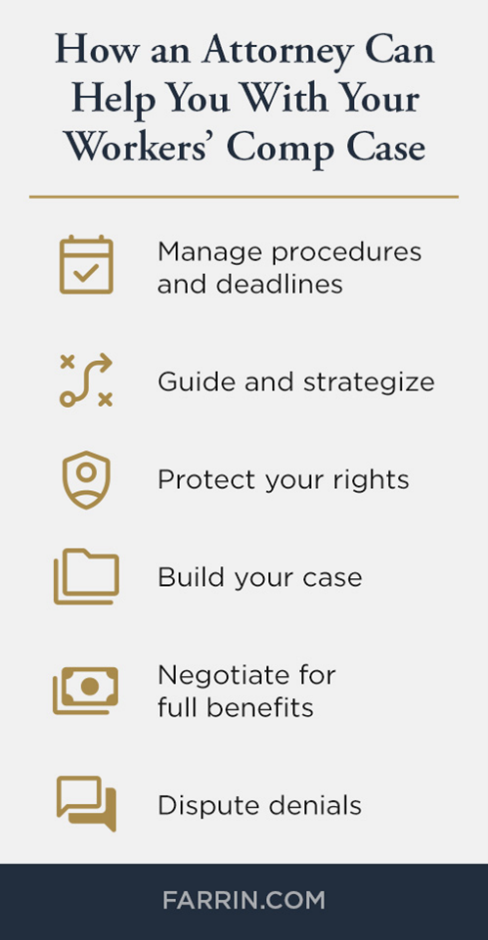
An experienced workers’ compensation attorney can help by:
- Gathering necessary medical evidence to build a compelling case for the full extent of your disability
- Fighting for your right to seek a second medical opinion if you disagree with the impairment rating given by the insurance company’s chosen doctor
- Advising you on the critical potential decision of whether to accept payment for your impairment rating or pursue ongoing wage loss benefits
- Negotiating with the insurance adjuster to try to reach a fair settlement that accounts for any future medical needs and lost wages
Having someone on your side who understands the law and the tactics insurance companies use can provide tremendous peace of mind and significantly increase your odds of success in pursuing the maximum compensation possible for your injuries.
FAQs for Temporary and Permanent Disability Benefits in NC
Here are answers to some common questions I hear about temporary and permanent disability benefits in North Carolina.
 Text Us