

When my clients first tell me about their rideshare accidents, the story usually starts the same way: They needed a ride home from downtown Greensboro — maybe after a night at the Tanger Center, a pickup from Piedmont Triad International Airport, or just a quick trip across town – then there’s an accident.
Uber and Lyft have become part of daily life in the Triad, and nobody expects a routine ride to end in a collision. When it does, the people I represent are often overwhelmed by the confusing tangle of insurance policies, corporate disclaimers, and legal questions that follow.
Rideshare accidents in Greensboro are some of the more complex ones I handle. These claims involve multiple layers of potential coverage that shift depending on what the driver was doing at the exact moment of impact. I’ve seen firsthand how understanding these layers can mean the difference between my clients getting fair compensation and being left to cover their medical bills out of pocket.1
Key Takeaways About Greensboro, NC Rideshare Accidents
- North Carolina law requires Transportation Network Companies like Uber and Lyft to carry specific insurance coverage for drivers while logged into their apps.
- Insurance coverage levels change dramatically based on whether a driver is waiting for a ride request, en route to pick up a passenger, or actively transporting someone.
- Passengers injured during an active trip typically have access to up to $1 million in liability coverage from the rideshare company.
- The three-year statute of limitations for personal injury claims in North Carolina applies to rideshare accidents.
- Multiple insurance policies might apply to a single rideshare accident, typically making these claims more complex than standard car crashes.
How Rideshare Insurance Works in Greensboro, NC
North Carolina regulates Uber, Lyft, and similar services as Transportation Network Companies (TNCs) under Article 10A of Chapter 20 of the North Carolina General Statutes, legislation passed in 2015 that requires these companies to hold permits to operate and maintain specific insurance coverage for their drivers. This framework creates a tiered insurance system that kicks in at different levels depending on the driver’s status.
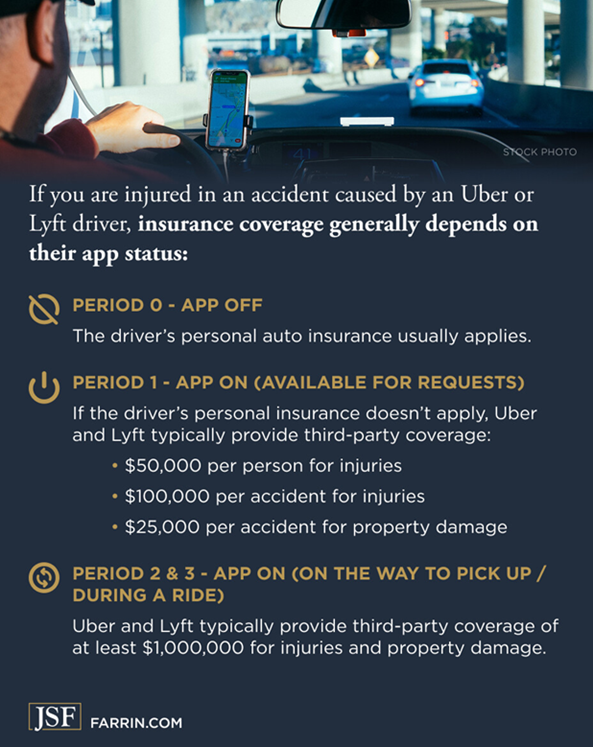
- Period 0 – App Off: If the driver is not logged into the rideshare app, their personal auto insurance is the primary potential coverage. However, many personal policies exclude business use, which can lead to coverage denials.
- Period 1 — App On, Waiting for a Request: When a driver is logged into the Uber or Lyft app but hasn’t accepted a ride yet, they must be covered by at least $50,000 for bodily injury to one person, $100,000 for bodily injury to two or more people, and $25,000 in property damage coverage. This coverage should act as a safety net when the driver’s personal auto insurance doesn’t apply.
- Period 2 — En Route to Pick Up a Passenger: Once a driver accepts a ride request and starts heading to pick someone up, higher coverage limits generally take effect. The rideshare company’s full commercial insurance policy typically provides coverage at this stage, which can include up to $1 million in liability for bodily injury.
- Period 3 — Passenger in the Vehicle: The strongest potential protection applies when you’re actually riding in the vehicle. Both Uber and Lyft maintain $1 million in liability coverage during this phase, plus uninsured and underinsured motorist coverage that can protect passengers if another driver causes the crash but lacks adequate insurance.
Understanding which period applies to your situation is critical because it determines which insurance policy may cover your injuries and how much compensation might be available.
Why Do Greensboro Rideshare Accidents Happen?
Rideshare drivers face unique pressures that can contribute to crashes, including:
- Distracted driving from app use: Drivers must monitor their phones for navigation, accept ride requests, and communicate with passengers, all while operating a vehicle in traffic.
- Fatigue from long hours: Many rideshare drivers work extended shifts or juggle driving with other jobs, leading to exhaustion behind the wheel.
- Unfamiliarity with routes: Picking up and dropping off passengers throughout the Greensboro area means drivers often travel through neighborhoods they don’t know well.
- Pressure to maximize earnings: Since drivers earn money per ride rather than per hour, some may rush between pickups or take risks to complete more trips.
- Poor vehicle maintenance: Unlike commercial fleets with strict inspection schedules, rideshare vehicles are likely personally owned and might not receive regular maintenance.
These factors can combine with typical crash causes like speeding, running red lights, and following too closely to create situations where passengers, pedestrians, and other motorists get hurt.
Filing a Rideshare Injury Claim in Greensboro, NC
Pursuing compensation after a rideshare accident requires understanding who might be responsible and which insurance policies may apply. Several parties could potentially be held liable:
- The Rideshare Driver: If the Uber or Lyft driver caused the accident through careless driving, speeding, or other negligent behavior, they can be held responsible. The applicable potential insurance coverage depends on their app status at the time of the crash.
- Another Driver: If someone else caused the collision, you would typically file a claim against that driver’s insurance. However, if they’re uninsured or don’t have enough coverage, the rideshare company’s uninsured/underinsured motorist coverage might help fill the gap.
- The Rideshare Company: Uber and Lyft classify rideshare drivers as independent contractors, not employees, which makes it more difficult to hold the companies directly responsible for a driver’s negligence. However, claims might be possible if the company failed to properly screen a driver or retained someone with a dangerous driving history.
The process typically involves reporting the accident through the rideshare app, gathering evidence from the scene, seeking medical treatment, and then filing claims with the appropriate insurance companies. Because multiple policies might apply, these claims can quickly become complicated.
What Steps to Take After a Greensboro Rideshare Accident
Once the immediate emergency has passed, taking certain steps can help protect both your health and your potential claim:
- Get Complete Medical Documentation: Follow up with your doctor or visit an urgent care clinic to get a thorough evaluation. Keep all records of treatments, prescriptions, and referrals. This documentation may become essential evidence for connecting your injuries to the accident.
- Preserve Evidence from the Ride: Screenshot your trip details from the Uber or Lyft app before they disappear. This information proves you were a passenger at the time of the crash and identifies the driver.
- Gather Contact Information: If possible, get names and phone numbers from witnesses, the rideshare driver, and any other drivers involved. Note the driver’s license plate number and rideshare identification.
- Request the Police Report: North Carolina law requires accident reports for crashes involving injury. You can request a copy through the City of Greensboro’s accident report services.
- Be Careful with Insurance Company Communications: Some insurance adjusters — whether from the rideshare company or another driver’s carrier — may try to minimize what they pay. Don’t accept a quick settlement offer; you might not know the full extent of your injuries or prognosis yet.
- Contact an Attorney Before Agreeing to Anything: Speaking with a Greensboro car accident injury attorney before giving recorded statements or accepting settlement offers helps protect your rights and gives you a clearer picture of what your claim might actually be worth.
Taking these steps early can strengthen your position when dealing with insurance companies and help preserve evidence that might otherwise disappear.
Understanding North Carolina’s Deadline for Filing Claims
North Carolina gives injured people a limited window to take legal action. Under N.C. General Statute § 1-52, the personal injury statute of limitations is generally three years from the date the injury occurred. If you miss this deadline, you typically lose the right to pursue compensation through the courts, no matter how serious your injuries may be.
While three years sounds like plenty of time, building a strong case takes significant effort. Evidence needs to be gathered while it’s still available. Witnesses’ memories fade. Medical records need to be collected and reviewed. Starting the process sooner rather than later gives your legal team more time to build your case and protect your interests.
Certain situations might affect this timeline. If the injured person was a minor at the time of the accident, different rules apply. Some injuries that aren’t immediately apparent might qualify for an extended deadline under what’s called the “discovery rule.” An attorney can help determine which deadlines apply to your specific situation.
How Insurance Companies Handle Rideshare Claims
Both Uber and Lyft have insurance adjusters who handle claims involving their drivers. These adjusters work for the insurance company, not for you, and their goal is often to pay out as little as possible. Some might use tactics like:
- Requesting recorded statements, hoping you’ll say something that undermines your claim
- Offering quick settlements before you know the full extent of your injuries
- Claiming the driver’s app wasn’t active at the time of the crash
- Arguing that your injuries existed before the accident or came from another source
- Delaying the claims process, hoping you’ll accept less just to get it resolved
Having legal representation levels the playing field against these large companies and their experienced insurance teams.
Possible Compensation After a Rideshare Accident Injury
People injured in Greensboro rideshare accidents might be able to recover compensation for various harms and losses:
- Medical expenses: Past, current, and future costs for hospital stays, surgeries, doctor visits, physical therapy, medications, and medical equipment
- Lost wages: Income you couldn’t earn because of your injuries, potentially including future earning capacity if your injuries prevent you from returning to your previous work
- Pain and suffering: Physical discomfort and emotional distress caused by your injuries and the accident itself
- Loss of enjoyment of life: Potential compensation for activities, hobbies, or experiences you can no longer participate in because of your injuries
The specific amount that may be available depends on factors including the severity of your injuries, potential insurance coverage limits, and the evidence supporting your claim.
FAQs for Rideshare Accidents in Greensboro
Here are answers to some common questions people have after being hurt in Uber or Lyft accidents in the Greensboro area.