
In most North Carolina T-bone accidents, the driver who failed to yield the right-of-way is considered at fault. Although the sudden, violent nature of a side-impact crash can leave you feeling disoriented, injured, and confused, the question of responsibility may seem obvious to you.
Unfortunately, proving who is at fault for a T-bone accident in North Carolina involves navigating complex rules, gathering specific evidence, and understanding how some insurance companies may try to place the blame on you.
As a personal injury attorney, I understand that you are likely facing a difficult and painful time after your crash. Your focus should be on your recovery, and an experienced personal injury attorney can guide you through the key factors used to determine fault in a North Carolina T-bone collision, including the fundamental traffic laws and the unique legal challenges our state presents.
In this article, I will explore how evidence is gathered, what common scenarios look like, and why an initial assessment of fault is often just the beginning of the story.
Key Takeaways – Who Is at Fault for a T-Bone Accident in North Carolina
- The driver who violates right-of-way rules is typically at fault in North Carolina T-bone accidents, with violations including running red lights, failing to yield at stop signs, and improper left turns.
- North Carolina’s contributory negligence rule may bar recovery if the injured party contributed even slightly to the accident, making fault determination critical.According to North Carolina law, if you are deemed to be even 1% at fault for the accident that caused your injury, you could be denied compensation.
- Essential evidence can include police reports, witness statements, physical scene evidence, surveillance footage, and accident reconstruction expert analysis as necessary.
- The “Last Clear Chance” doctrine may overcome contributory negligence if the at-fault driver had the final opportunity to avoid the collision.
- Insurance companies often use North Carolina’s strict fault rules to deny claims, but experienced legal representation can significantly increase your odds of success.
The Devastating Impact: What Is a T-Bone Accident?
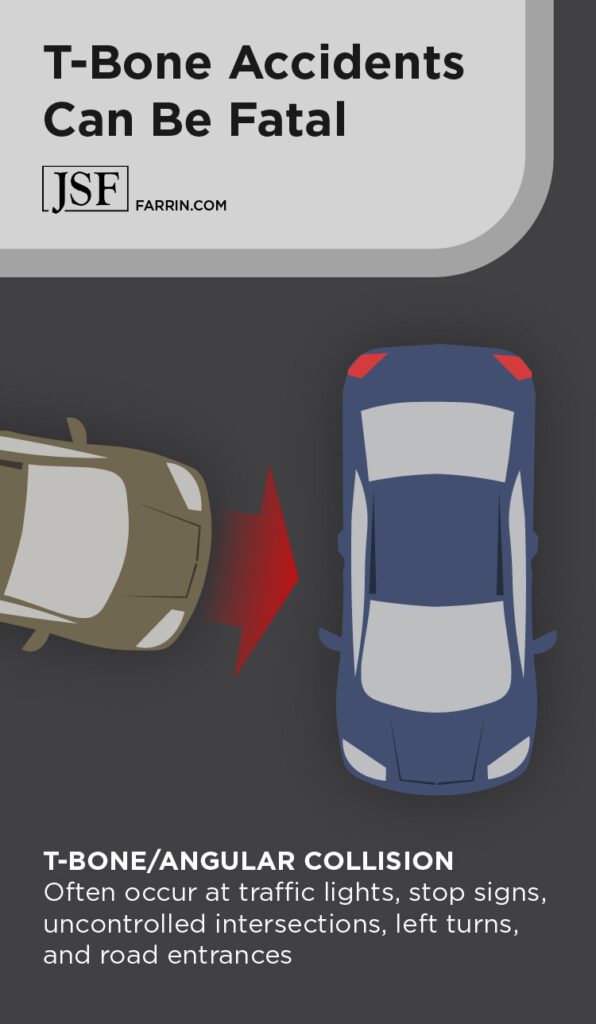 A T-bone accident, also known as a side-impact or broadside collision, occurs when the front of one vehicle crashes into the side of another, forming a “T” shape. These collisions most frequently happen at intersections, in parking lots, or in other places where paths of travel cross.
What makes T-bone crashes particularly dangerous is the simple physics of vehicle design. Cars, trucks, and SUVs are built with significant safety features in the front and rear of the vehicle. Large bumpers, crumple zones, and the engine block work to absorb the force of a collision. The sides of a vehicle, however, usually have only a door and a window to protect the occupants.
The results are often devastating. According to the Insurance Institute for Highway Safety (IIHS), side-impact collisions accounted for 22% of passenger vehicle occupant deaths in one recent year. T-bone crash injuries sustained can be catastrophic, including:
- Broken hips and pelvises
- Severe internal organ damage and bleeding
- Multiple bone fractures in the arms, legs, and ribs
To bring your claim for a T-bone collision, it’s critical to have a proper and thorough fault investigation. Your potential compensation for medical bills, lost income, and pain and suffering may depend on it.
The Core Principle of Fault: Understanding How Right-of-Way Affects Side Impact Cases in North Carolina
The foundation of determining fault in a T-bone crash rests on one key concept: right-of-way. Right-of-way rules are the traffic laws that dictate who has the legal right to proceed and who must wait for others to pass. A driver who violates these rules and causes a collision is generally considered negligent and, therefore, at fault.
The North Carolina Driver’s Handbook, published by the North Carolina Department of Transportation (NCDOT), outlines these rules in detail. Understanding these regulations helps clarify how fault is typically assigned.
Here are some common right-of-way situations that lead to T-bone accidents:
Controlled Intersections (Traffic Lights)
Traffic signals provide clear guidance about who may proceed and who must wait. Understanding these signals is fundamental to safe driving and determining fault when accidents occur.
Key traffic light rules include:
- Solid Green Light: A driver facing a solid green light has the right-of-way to proceed straight through the intersection.
- Solid Red Light: A driver facing a solid red light must stop completely before the crosswalk or intersection and remain stopped. Running a red light is a clear violation of right-of-way.
- Solid Yellow Light: A yellow light is a warning that the signal is about to turn red. A driver should stop if they can do so safely. Proceeding cautiously through a yellow light is sometimes permissible, but accelerating to “beat the light” can be considered negligent.
- Green Arrow: A driver facing a green arrow has the right-of-way to make the turn indicated by the arrow.
Controlled Intersections (Stop Signs)
Stop signs create specific obligations for drivers that, when violated, can lead to devastating T-bone collisions. The rules vary based on the type of intersection configuration.
Common stop sign scenarios include:
- Two-Way Stop: If you approach an intersection with a stop sign but the cross-traffic does not, you must stop and yield to oncoming traffic before proceeding. Pulling out in front of a car that doesn’t have a stop sign is a primary cause of T-bone crashes.
- Four-Way Stop: At a four-way stop, the first vehicle to arrive and stop has the right-of-way. If two vehicles arrive simultaneously, the driver on the right has the right-of-way.
Uncontrolled Intersections
In residential areas or rural parts of North Carolina, you may encounter intersections with no signs or signals. The rule here is the same as a four-way stop: you must generally yield to the vehicle on your right.
Left Turns
This is a major source of side-impact collisions. A driver turning left at an intersection must yield to oncoming traffic that is proceeding straight or turning right, unless they have a green arrow. Misjudging the speed or distance of an oncoming car can lead to a tragic T-bone crash.
Entering a Roadway
Any vehicle pulling out from a private driveway, a parking lot, or an alley must yield the right-of-way to traffic already on the main road.
Violating any of these fundamental rules can be strong evidence of negligence. However, in North Carolina, simply proving the other driver was negligent may not be enough.
How Is Fault Actually Proven? The Evidence That Matters
When it comes to a legal accident claim, determining fault is not about what you “feel” happened; it’s about what you can prove with credible evidence. A strong case may be built by gathering and preserving as much information as possible from the moment the crash occurs (if possible). This is where an experienced North Carolina car accident lawyer can be a valuable asset and ally.
The Official Police Report
 When law enforcement responds to the accident scene, officers conduct a preliminary investigation. They interview drivers and witnesses, observe the position of the vehicles, and note the road conditions. Their findings are documented in a police report, which often includes the officer’s initial opinion on who may have violated a traffic law and contributed to the crash.
The police report can be a powerful piece of evidence, but it is not the final word on fault. Officers can make mistakes, and their conclusions are ultimately an opinion, not a legally binding judgment.
Physical Evidence From the Scene
 The scene of the crash itself tells a story. The location and severity of the damage to both vehicles may help establish the angle of impact and the speeds involved. For example, deep intrusion into the passenger side door indicates a T-bone, and the extent of the damage can point to excessive speed.
Other crucial physical evidence can include:
- Skid Marks: Their length and direction can help calculate braking distance and vehicle speed.
- Debris Field: The location of broken glass and vehicle parts can help pinpoint the exact location of the impact.
Photographs and Video Footage
 In today’s world, visual evidence is king. If you are able, taking pictures and videos with your phone at the scene is important. I recommend capturing wide shots of the intersection, the damage to both cars from multiple angles, the other driver’s license plate, skid marks, and any relevant traffic signs or signals.
Objective video footage might be even more powerful and can make the difference between winning and losing a case. This crucial evidence might come from several key sources:
- Dash Cams: If you or the other driver had a dash cam, the footage could more definitively show who had the right-of-way.
- Traffic Cameras: Many intersections in cities across North Carolina are monitored by NCDOT or city traffic cameras.
- Business Surveillance: Nearby businesses often have security cameras that may have captured the collision.
I’ve worked with skilled investigators who know exactly how to obtain this evidence through legal processes you might not know exist.
Eyewitness Testimony
 An independent third-party witness who saw the T-bone accident happen can be incredibly persuasive. A neutral observer who can state, “I saw the red car run the stop sign and hit the blue car,” provides a powerful counter-narrative to any attempts by the at-fault driver to change their story later. It is vital to get the names and contact information of any witnesses before they leave the scene.
Accident Reconstruction Reports
 In complex cases where fault is heavily disputed, it may be necessary to hire an accident reconstruction expert.
These are professionals, often with engineering or law enforcement backgrounds, who use physics, mathematics, and specialized software to scientifically reconstruct the crash. They can analyze available evidence to provide an expert opinion on vehicle speeds, driver behaviors, and the sequence of events that led to the collision, which can be critical in overcoming a contributory negligence defense.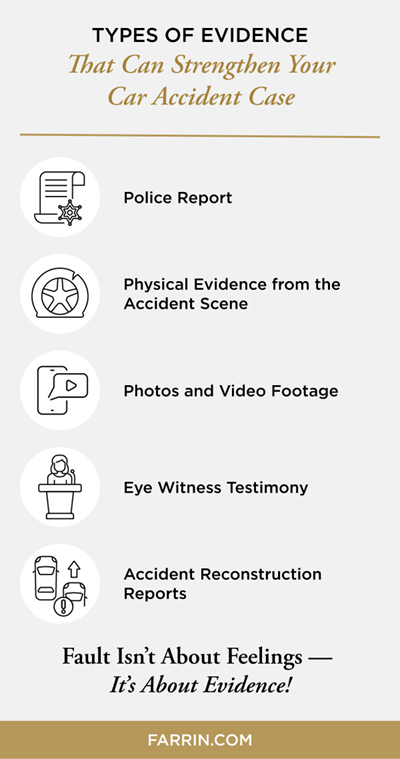
What if Both Drivers Share Some Blame? The “Last Clear Chance” Doctrine
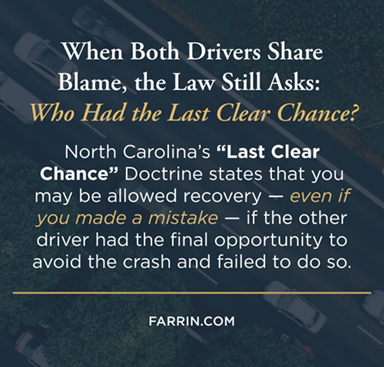 While North Carolina’s harsh contributory negligence rule is a challenging hurdle for some accident victims, North Carolina law provides a very specific counterargument, known as the Doctrine of Last Clear Chance.
This doctrine can sometimes overcome a contributory negligence defense. It applies if you can prove that even though you may have been slightly negligent, the other driver had the final opportunity – the “last clear chance” – to avoid the collision but failed to do so.
For example, imagine you had to make a U-turn in the middle of a block, and your car stalls in the other lane. Another driver is approaching, but they are distracted, not noticing your stalled car until it’s too late. You may share some responsibility for the accident. However, your lawyer might argue that the other driver was contributorily negligent for being distracted. Under the Last Clear Chance doctrine, you could argue that the other driver, seeing your stalled vehicle, had time to stop or swerve but did nothing. They had the last opportunity to prevent the crash.
This is a highly technical legal argument that requires a sophisticated understanding of case law, and it is another reason why navigating a serious T-bone accident claim on your own is so challenging. A knowledgeable car accident attorney can review your unique circumstances and explain whether this doctrine might apply to your claim.
Question the Insurance Company
After the shock of the accident, you might receive a call from the other driver’s insurance adjuster. It is crucial to remember this person’s role. Despite the friendly and concerned tone you’re likely to hear, their job as adjusters for a for-profit insurance company includes protecting their company’s financial interests. Some adjusters may pay out as little as possible on your claim, no matter how hurt you may be.
Some of these adjusters may use North Carolina’s contributory negligence rule as their primary tool by:
- Asking for a recorded statement: They might try to get you to say something they can twist to imply you were partially at fault.
- Pressuring you for a quick, lowball settlement: They may offer a small amount of money upfront, before you even know the full extent of your injuries, in exchange for you signing away future rights to seek compensation.
You are under no obligation to give the insurance claims adjuster a recorded statement. To help protect yourself, be polite but firm, and direct further communication to an experienced legal representative who is protecting your rights.