

As an attorney, one of the most common fears I hear from people hurt on the job is, “Can I be fired for filing a workers’ comp claim in North Carolina?” It’s a completely valid concern. You’re dealing with a physical injury, medical costs are piling up, and the last thing you need is the stress of losing your job and your income. The thought of being punished for seeking benefits you might be entitled to can be very troubling.

Let me start by giving you the direct answer: No, your employer cannot legally fire you for filing a workers’ compensation claim. State law is very clear on this. However, that doesn’t mean it never happens. Sometimes, employers try to find other reasons to let an employee go, masking the true, retaliatory motive.
Recognizing the actions that might be considered retaliation after filing a workers’ compensation claim in North Carolina, and understanding the laws that protect injured workers, is crucial in helping protect yourself should you find yourself in this difficult situation.
Key Takeaways About Whether You Can Be Fired for Filing a Workers’ Comp Claim in NC
- North Carolina’s Retaliatory Employment Discrimination Act (REDA) makes it illegal for an employer to fire or otherwise discriminate against an employee for filing a workers’ compensation claim.
- Filing a workers’ comp claim, reporting a work injury, or testifying in a workers’ comp case are generally considered legally “protected activities.”
- Retaliation can take many forms besides termination, including demotion, reduced hours, harassment, or a sudden negative change in job duties.
- Proving that a firing was retaliatory often requires showing a close connection in time between the workers’ comp claim and the negative employment action.
- An employee who successfully proves a retaliatory discharge claim might be able to recover lost wages or even be reinstated to their job.
Your Rights Under NC Law
The primary shield protecting injured employees in our state is the Retaliatory Employment Discrimination Act, or REDA. This law says that an employer is not allowed to take negative action against an employee because that employee engaged in a “protected activity.”
When it comes to workplace injuries, filing a claim for workers’ compensation benefits is one of the most important protected activities under this law. The entire workers’ compensation system is designed to provide a safety net for people injured at work.
REDA cases are a complex area of law. The system wouldn’t work if employees are too afraid of losing their jobs to use it. REDA exists to uphold that principle and give you a way to fight back if an employer violates your rights. I will provide more information here about this law, but I urge you to also go to the North Carolina Department of Labor’s REDA website or consult with a lawyer who focuses primarily on REDA cases if you feel your employer has violated this law.
What Is a “Protected Activity”?
The term “protected activity” sounds like legal jargon, but the concept is simple. It refers to any action an employee can take that is specifically protected by law, meaning an employer cannot punish them for doing it.
In the context of a workers’ compensation case, protected activities include:
- Filing a good-faith claim for workers’ compensation benefits after a work-related injury
- Reporting a work injury to your supervisor or manager in accordance with company policy
- Participating in an investigation or providing testimony in a workers’ compensation hearing, either for your own case or for a coworker’s
- Contacting or hiring an attorney to get help with your workers’ comp case
Engaging in any of these actions should not put your job at risk, and REDA is the law that provides that protection.
Recognizing Retaliation: It’s Not Always Obvious
When people ask if they can be punished for filing a workers’ comp claim in North Carolina, they are usually thinking of the most direct form of retaliation — termination. For example, an employee files their claim, and a week later, they are called into the office and let go. While this does happen, retaliation can often be more subtle.
An employer who wants to punish an employee for filing a claim might try to make their work life so difficult that they quit. Any negative action taken by an employer that would discourage a reasonable person from pursuing their claim can potentially be considered retaliation. This is often referred to as an “adverse employment action.”
Here are some examples of what retaliation might look like:
- A sudden and unexplained termination shortly after you report your injury
- Being demoted or transferred to a less desirable position with lower pay or status
- Having your work hours drastically cut
- Receiving your first-ever negative performance review right after filing your claim
- Being subjected to new and intense scrutiny or harassment by a supervisor
- Being excluded from important meetings, training, or opportunities for advancement
- An unexplained change in your job duties to tasks that are either more difficult or conflict with your medical restrictions
These actions, especially when they occur soon after you’ve engaged in a protected activity, can be strong indicators of illegal retaliation. To help determine if you may have a REDA complaint, click here.
The Challenge: Proving Your Employer’s Motive
This is typically the hardest part of any retaliation case. An employer will almost never admit, “I’m firing you because you filed for workers’ compensation.” Doing so would be admitting they broke the law. Instead, they will almost always provide a different, legitimate-sounding reason for their decision. This may simply be a “pretext.”
Pretexts may include:
- “Company restructuring” or “layoffs:”The company claims your position was eliminated for business reasons, even if you are the only one let go.
- “Poor performance:”They might suddenly claim your work isn’t up to par, despite a history of positive reviews.
- “Violation of company policy:”They might discipline or fire you for a minor infraction that other employees commit without consequence, such as being a few minutes late.

Building a Case for Retaliatory Discharge
To try to prove retaliation, you should look for patterns and evidence that undermine your employer’s story, focusing on several key areas.
- One of the most significant factors is timing. If an adverse employment action happens very soon after you file your claim or report your injury, it can create a strong inference of retaliation. While not definitive proof on its own, close timing can be a powerful piece of circumstantial evidence.
- Inconsistent reasoning is often a focal point. Has your manager’s story about why you were fired changed over time? Do the reasons given in your termination letter conflict with what you were told in person? These inconsistencies can suggest that the stated reason is a fabrication.
- Another area to examine is the treatment of other employees. Were you disciplined for something that other employees do all the time without getting in trouble? If the company is applying its policies unevenly and only targeting you, it can be evidence of a retaliatory motive.
- Whether the employerdeparted from its own policies is often a key part of your potential case. Most companies have established procedures for discipline and termination. If they skipped steps or failed to follow their own handbook when dealing with you, it raises questions about their true intentions. Your own positive work history can also be a critical piece of evidence to counter a sudden claim of “poor performance.”
What to Do if You Suspect You Were Fired in Retaliation
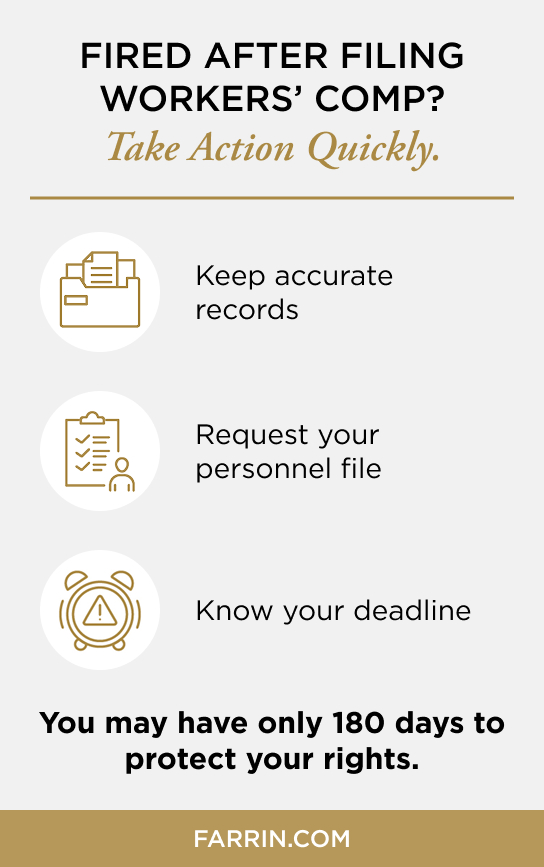 If you believe you have lost your job or faced other negative consequences because of your workers’ comp claim, it is important to act methodically. The steps you take can greatly impact your ability to protect your rights.
- Document Everything. Create a detailed timeline of events. Write down the date of your injury, the date you reported it, the date you filed your claim, and the dates of any negative actions taken against you. Save all related documents, including emails, text messages, performance reviews, and your termination letter.
- Request Your Personnel File. North Carolina law gives you the right to inspect your personnel file. This file can contain important information, such as performance reviews and disciplinary records (or a lack thereof), which can be useful in building your case.
- Be Aware of the Deadline. This is critical. Under REDA, you have a very limited time to act. You generally must file a complaint with the North Carolina Department of Labor’s Employment Discrimination Bureau within 180 days of the retaliatory act. If you miss this deadline, you could lose your right to pursue a claim.
Taking these steps can help protect your ability to seek justice if your rights were violated.
What Are the Potential Outcomes of a Successful REDA Claim?
If you are able to prove that you were fired for filing a workers’ comp claim, REDA provides for several potential remedies. The goal of the law is to make the victimized employee “whole” again, as if the illegal retaliation never occurred.
A successful claim may result in one or more of the following outcomes:
- Reinstatement:You could be offered your old job back.
- Back Pay:You could receive compensation for the lost wages and benefits you would have earned from the date of your termination.
- Other Damages:You could potentially be awarded compensation for other financial losses connected to the wrongful termination.
It is important to remember that every case is different, and these outcomes are not guaranteed. However, the law provides you a clear path to fight for these remedies if your employer has broken the law.
FAQs for Can I Be Fired for Filing a Worker’s Comp Claim in NC
Here are answers to some additional questions I often hear from injured employees about their job security.
 Text Us