


A car accident can be a frightening and chaotic event. In the immediate aftermath, it can be difficult to think clearly, especially if you have been injured. One of the most important questions you may have is: “Who is at fault for this?” The answer to this question generally determines who is responsible for paying for your medical bills, lost wages, and other damages.
While the circumstances may seem obvious at first, determining fault can be a complex legal process that involves a careful analysis of evidence, traffic laws, and state-specific regulations. As a car accident attorney licensed in North and South Carolina, I have helped many car accident clients assess which driver was at fault in their accident and have built compelling cases seeking compensation from the at-fault parties.
Understanding how fault is determined is an important first step for protecting your rights and pursuing the compensation you may need. Let’s look at how to tell who is at fault in a car accident, the type of evidence that goes into this determination, and how an attorney can help you navigate the legal claims process.
Key Takeaways About Determining Fault After a Car Crash
- Insurance companies will determine who is at fault in an accident before they make any settlement offers.
- If the insurer does not agree with your legal team’s fault assessment, you may need to bring your claim to trial through the court system.
- Key evidence for determining fault includes police reports, photographs, witness statements, and physical evidence from the scene.
- Traffic violations, such as speeding or running a red light, are often strong indicators of negligence.
- North Carolina and South Carolina have different laws that can affect an injured plaintiff’s ability to recover compensation.
- An attorney can help to investigate your crash, build a compelling case, and fight for the compensation you may deserve.
How to Determine Fault, or Legal Liability, After an Auto Accident
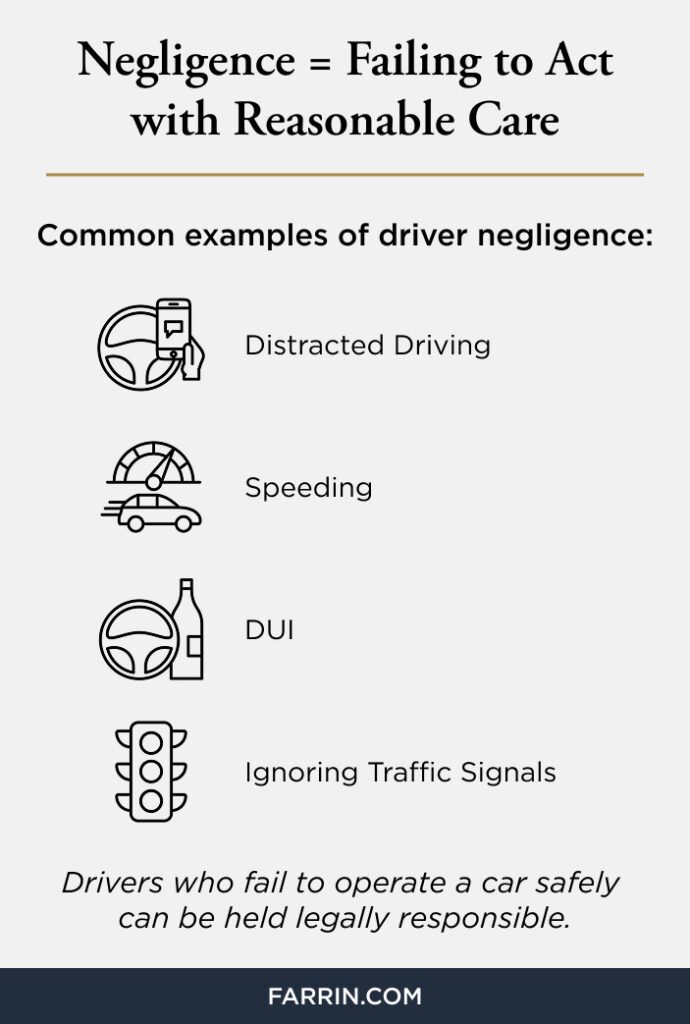 Car accidents are typically caused by a driver who was acting negligently. Negligence is a legal term that generally means a person failed to exercise reasonable care and, as a result, caused harm to another person.
- Negligence and Basic Legal Principles: Every driver on North and South Carolina roads has a duty to operate their vehicle safely. When a driver fails to do so, they may be found to be negligent. Examples of negligence can include:
- distracted driving
- speeding
- driving under the influence of alcohol or drugs
- failing to obey traffic signals
One of the most important jobs of a personal injury lawyer is to try to prove that the other driver’s actions were the cause of the accident (i.e. determining fault).
- Evidence: The evidence from the accident scene can help provide a clear picture of what happened. This may include photographs, video footage, physical evidence, and witness statements.
To prepare your claim for potential settlement discussions or trial, your legal team will gather relevant evidence to help build a strong case on your behalf.
- Applying the Law: The state where the accident occurred has specific laws that apply to personal injury claims. You must follow those laws, including meeting any filing deadlines, to pursue a claim for accident-related financial losses known as legal damages.
Key Evidence That May Help Prove Who Was at Fault
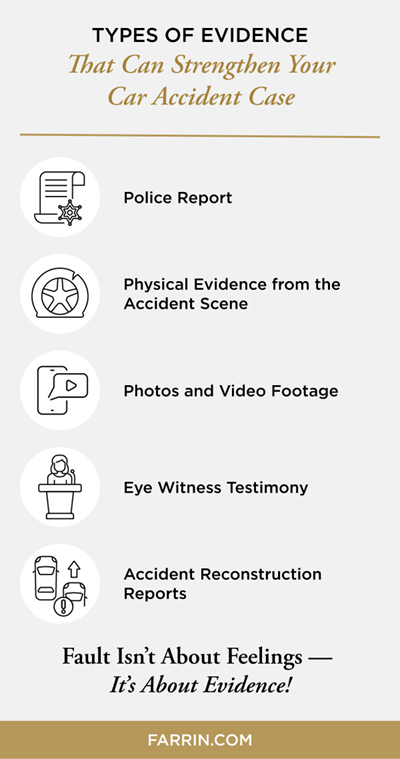
The process of determining fault begins with a thorough investigation of the crash. The more evidence that can be gathered, the stronger your case can be. Some of the most important pieces of evidence may include:
- The police report: The police report is often the first piece of evidence an insurance company or an attorney will examine. It should contain a diagram of the accident, a description of the crash, and the officer’s initial determination of fault. The report may also include information about any traffic citations that were issued.
- Photographs and video: Photographs and videos of the accident scene can be extremely helpful pieces of evidence. They may include the damage to both vehicles, the position of the cars, and any relevant street signs or signals. If there were any dash cams or security cameras in the area, the footage can also be a crucial piece of evidence.
- Witness statements: Independent witnesses can provide an unbiased account of what happened. They may have seen things that the drivers did not, and their statements can be a key part of the investigation.
- Physical evidence: The physical evidence from the accident scene, including skid marks, debris, and the location of the cars, can help reconstruct the crash from a scientific perspective.
Your medical records are also a crucial piece of evidence in your personal injury case. They can help to document the extent of your injuries and the medical treatment you received that was related to the collision.
The Role of the Insurance Company
After an accident, the insurance company will generally open a claim and assign an adjuster to the case. The adjuster’s job is to investigate the accident and determine who was at fault. The insurance company will use the evidence that has been collected, along with its own internal investigation, to determine who it thinks caused the accident.
If the other driver is at-fault, their insurance company may offer you a quick settlement. You should not accept it without first speaking with a lawyer. The insurance company’s interests are generally in protecting its own bottom line, and some adjusters may offer you a lowball settlement in the hopes that you will accept it without understanding the full value of your case.
State-Specific Laws and Their Impact on Your Case
The laws of the state where the accident occurred can have a significant impact on your ability to recover compensation. While the fundamental principles of negligence are the same, the laws that govern how fault is applied vary from state to state.
North Carolina Laws Related to Personal Injury Claims
In North Carolina, the statute of limitations for personal injury is generally three years from the date of the accident. For a wrongful death claim, the statute of limitations is generally two years. If you do not file a lawsuit within this time, you may be barred from recovering any compensation.
The laws in North Carolina are different from those in many other states. The insurance company may try to argue that you contributed to the accident, which can impact your ability to recover any compensation. It is important to have a legal professional evaluate your case. An experienced attorney can help you identify all of the potentially at-fault parties and build a compelling case to try to prove that other people’s negligence caused the accident.
South Carolina Laws Related to Car Accident Claims
The statute of limitations in South Carolina is generally three years for both personal injury and wrongful death claims. This is different from North Carolina’s law and shows why it is important to consult with a legal professional who understands the specific laws of your state.
South Carolina follows a modified comparative fault system. This means that if you are found to be partially at fault for an accident, you may still be able to recover compensation, as long as your fault is not greater than 50%. The amount of compensation you can potentially receive would then be reduced by your percentage of fault.
Contact an experienced car accident law firm in the state where your accident happened. Many firms, such as mine, offer a free consultation where you can ask questions and determine if the firm is the right fit for you and your case.
How a Dedicated Injury Attorney Can Benefit Your Claim
A car accident can turn your life upside down in an instant. You may be facing physical pain, emotional distress, and mounting medical bills. The legal process can be complex and intimidating, especially when you are trying to recover from your injuries. A dedicated lawyer can help you with the following:
- Investigating the Accident: An attorney can launch an investigation into your accident, including collecting all available evidence, interviewing witnesses, and working with investigators as needed to reconstruct the accident scene.
- Handling the Insurance Company: Some insurance adjusters may try to get you to admit fault or to accept a lowball settlement. A lawyer can help protect you from these tactics. They can handle communication and negotiation with the claims adjuster on your behalf.
- Building a Compelling Case: An experienced legal team can help you build a strong legal case by identifying all potentially liable parties and dedicating extensive assets to try to prove that the other driver’s negligence or another party caused your injuries.
- Negotiating Liens: If you have medical bills or health insurance liens, a lawyer can advise and negotiate with the lienholders to try to put more money in your pocket.
- Fighting for Compensation: A lawyer can help you assess the full extent of your potential losses and fight for the full compensation you may be owed.
 Text Us