


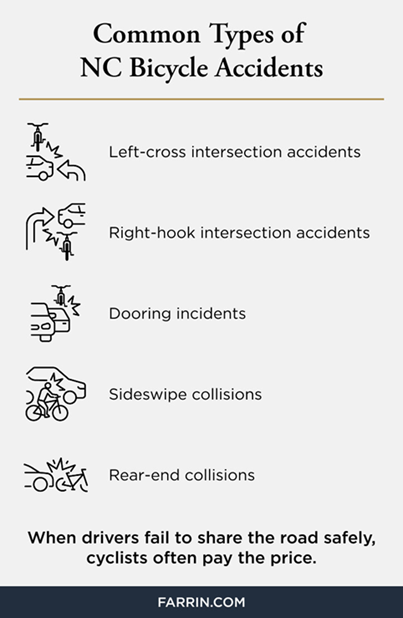
As an attorney, I’ve seen that the most common types of bicycle accidents in North Carolina often happen when a car and a bike cross paths, especially at intersections. These incidents frequently involve a driver turning left or right without seeing the cyclist, or a driver opening their car door into a bike lane.
While every crash is different, understanding these common scenarios can help you recognize when a driver’s mistake may have caused you harm and when you might have grounds to seek compensation for your injuries.
The details of how and where the accident happened are incredibly important in building a compelling case for compensation, and I want to walk you through some of the situations I see most often in my practice.
If you’re a cyclist injured in an accident, call James Scott Farrin for a free case evaluation by an experienced professional today at 1-866-900-7078.
Key Takeaways About the Most Common Types of Bicycle Accidents
- Intersections are high-risk areas where many of the most common types of bicycle accidents occur, often due to drivers failing to yield the right-of-way.
- “Dooring” accidents, where a driver opens a car door into an approaching cyclist’s path, are a significant danger in urban environments.
- North Carolina law generally grants cyclists the same rights and responsibilities as operators of other vehicles.
- Distracted driving, such as texting or using a phone, is a major contributing factor in many serious auto collisions with cyclists.
- Following a bicycle accident, gathering evidence and understanding one’s legal options can be critical steps.
The Dangers at Intersections: A Primary Hotspot for Bicycle Accidents
Riding a bicycle in North Carolina, whether along the scenic Blue Ridge Parkway or through the busy streets of Charlotte, can be an enjoyable and memorable experience. Unfortunately, intersections present a serious risk to cyclists. In my experience, a significant percentage of bicycle accidents happen where roads cross. A driver’s momentary lapse in attention here can lead to life-altering consequences for a cyclist.
These situations often come down to a driver’s failure to properly look for and yield to a cyclist. There are a few scenarios that I see repeatedly.
Left-Cross Accidents
A “left-cross” is one of the most frequent collision patterns. This happens when a car making a left turn at an intersection drives directly into the path of a cyclist who is riding straight through the intersection from the opposite direction.
The driver may not have seen the cyclist for several reasons:
- They were focused on looking for gaps in oncoming vehicle traffic and failed to notice the smaller profile of a bicycle.
- An object, like a large truck or bus, may have temporarily blocked their view of the cyclist.
- They simply misjudged the cyclist’s speed, assuming they had more time to complete the turn than they actually did.
No matter the reason, the cyclist is often left with little to no time to react.
Right-Hook Accidents
The “right-hook” is another common type of bicycle accident that occurs at intersections. This crash happens in one of two ways. First, a driver might pass a cyclist on the left and then make an immediate right turn, cutting the cyclist off. Second, a driver may pull up alongside a cyclist at a light and then turn right directly into their path when the light changes.
In both cases, the driver fails to yield the right-of-way. In North Carolina, a driver must make sure it is safe before turning. Failing to account for a cyclist in a bike lane or on the shoulder when making a right turn can be a clear example of negligence.
Understanding these intersection dynamics is crucial because they highlight how drivers’ actions — or inactions — are often the root cause of these incidents.
When Drivers Fail to See What’s Right There: More Common Bicycle Accidents
Beyond intersections, cyclists face risks from drivers who aren’t paying close enough attention to their surroundings. In North Carolina, bicycles are legally defined as vehicles. This means you have a right to be on the road. When drivers forget this, the results can be devastating.
“Dooring” Incidents in Urban Areas
In cities like Raleigh or Durham, where street parking is common, “dooring” is a serious threat. This type of accident happens when a person in a parked car suddenly opens their door into the path of an approaching bicyclist.
Here are a few key points about dooring accidents:
- They are almost always preventable. A driver or passenger simply needs to check their mirrors and look over their shoulder before opening the door.
- The impact can throw a cyclist into the street and into the path of moving traffic, potentially causing a second, more severe collision.
- These incidents often cause serious injuries, including broken bones, facial trauma, and head injuries, even at low speeds.
A dooring accident can happen in an instant, leaving a cyclist with severe injuries and significant medical bills.
Sideswipe and Rear-End Collisions
Sideswipe and rear-end collisions can happen when drivers fail to give cyclists adequate space. A driver might try to squeeze past a cyclist in a narrow lane, misjudge the distance, and strike them from the side. Rear-end accidents can happen when a driver is following a cyclist too closely or is not paying attention and fails to stop in time.
These types of accidents can often be tied to a driver’s failure to follow basic safety rules. In North Carolina, drivers are required to pass cyclists with at least two feet of clearance, and more if possible. When they fail to do so, they put the cyclist in a very dangerous position.
In all of these scenarios, the common thread is a driver’s failure to safely share the road with a more vulnerable user.
North Carolina Bicycle Laws and a Driver’s Duty of Care
Understanding your rights is a key part of protecting yourself after a bicycle accident. As I mentioned, North Carolina law gives cyclists most of the same rights and responsibilities as motorists. You are allowed to ride on public roads (with some exceptions, like interstates) and are expected to follow traffic laws, such as stopping at red lights and stop signs.
However, drivers of motor vehicles have a responsibility — what the law calls a “duty of care” — to operate their vehicles safely to avoid harming others, including cyclists. When they fail to do so, they may be considered negligent.
To build a case for compensation, we generally have to establish three main things, which I sometimes call the “three-legged stool”:
- Negligence: The driver did something careless or broke a traffic law.
- Causation: The driver’s negligence directly caused the accident.
- Damages: You were harmed as a result, leading to medical bills, lost wages, and/or other losses.
Proving these elements can be complicated, especially in North Carolina. Some insurance companies may often try to shift blame onto the cyclist to avoid paying a claim. This is a primary reason why having someone to fight for you can be so important. An attorney can help gather the evidence needed to try to prove the driver was at fault.
The Role of Distracted Driving in Bicycle Accidents
In today’s world, distracted driving is a massive problem, and cyclists are among the most vulnerable to its consequences. When a driver is looking at a phone, adjusting the radio, or is otherwise not focused on the road, they can easily miss seeing a cyclist until it’s too late.
According to the National Highway Traffic Safety Administration (NHTSA), over 3,000 people were killed annually in distracted driving crashes in recent years. While statistics often focus on car-on-car crashes, cyclists and pedestrians are often at an extremely high risk.
A few examples of distractions that can lead to common types of bicycle accidents include:
- Texting or emailing while driving
- Using a GPS or navigation system
- Talking on the phone (even hands-free can be a cognitive distraction)
- Eating or drinking
When I investigate a bicycle accident case, one of the first things I look for is evidence of distraction. This could include obtaining cellphone records or finding witnesses who saw the driver looking down before the crash. Proving distraction can be a powerful tool in establishing a driver’s negligence.
What to Do After a Bicycle Accident in North Carolina
After getting initial medical attention, the steps you take can be very important for your health and any potential injury claim. The time following an accident can be disorienting, but trying to stay organized can help protect your rights.
Here are a few things to consider doing once you are safe:
- Document Everything: Write down everything you remember about the accident while it’s still fresh in your mind. Note the time, location, weather conditions, and what happened. If you have visible injuries, take pictures of them regularly as they heal.
- Preserve Evidence: Do not repair your bicycle or throw away your damaged helmet or clothing. These items are important pieces of evidence that can show the force and nature of the impact.
- Follow Medical Advice: Attend all your doctor’s appointments and follow their treatment plan precisely. This is not only crucial for your recovery but also creates a clear medical record that can link your injuries to the accident.
Taking these steps can help create a strong foundation if you decide to pursue a claim for compensation.
How an Attorney Can Help Investigate Common Types of Bicycle Accidents
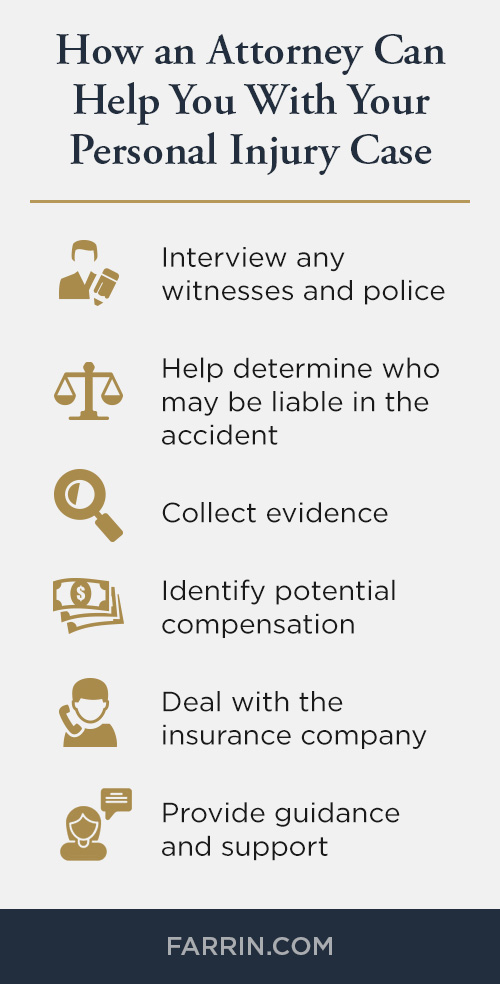
When you’re trying to recover from injuries, dealing with an insurance company is often the last thing you want to do. Insurance adjusters have a job to do, and that is often to pay out as little as possible. That’s where I, as an attorney, can step in to try to level the playing field.
My job is to handle all the complex aspects of your case so you can focus on getting better. Here’s what that often involves:
- Building Your Case: My team gathers and examines the evidence. This can include the police report, photos of the scene, and witness statements. If needed, we can work with investigators to reconstruct the accident scene to help demonstrate what really happened.
- Handling the Insurance Company: I take over communication with the insurance companies. I will present your case and negotiate on your behalf to counter any lowball tactics and fight for the full value of your harms and losses.
- Fighting for Maximum Compensation: My goal is to try to identify all possible sources of compensation. I will help calculate the full value of your claim, which may include current and future medical expenses, lost wages, pain, and other harms. We fight to get you as much as possible, as quickly as possible.
You should not have to face this difficult situation by yourself. An experienced attorney can be your advocate and guide you through the process every step of the way.
North Carolina Bicycle Accident FAQs
Here are some answers to other questions I frequently receive about the most common types of bicycle accidents in North Carolina.
 Text Us