

If you’ve been involved in a car accident in Greensboro, I know the aftermath can be overwhelming. The decisions you make in the hours and days that follow are critical and can significantly impact your potential to get fair compensation for your injuries. As an experienced car accident lawyer, I can tell you that knowing what to do after a car accident in Greensboro helps you protect both your health and your legal rights.

That’s why I’ve created this guide. I want to walk you through the essential steps to take once your immediate medical needs have been addressed. By understanding how to preserve important evidence and when it’s time to seek legal advice, you can make a significant difference in your case.
Key Takeaways About What to Do After a Car Accident in Greensboro
- North Carolina law requires immediate reporting of accidents involving injury, death, or property damage exceeding $1,000.
- Drivers generally have three years from the date of accident to file a personal injury lawsuit under North Carolina’s statute of limitations.
- Medical documentation often serves as crucial evidence linking injuries to the collision.
- Insurance companies represent their own interests, and most are for-profit companies with a focus on their bottom line.
- Consulting with a car accident attorney can help protect your legal rights, especially in complex cases.
- Greensboro experiences among the highest rates of injury-causing crashes in North Carolina.
Why Do Greensboro Drivers Face Higher Risks?
Before diving into the steps you should take, it helps to understand why car accidents in Greensboro tend to be more serious than in many other North Carolina cities. According to WFMY News 2, while Greensboro has fewer total crashes than Charlotte and Raleigh, about 36% of Greensboro crashes resulted in injury — putting the city at the top of the North Carolina Department of Transportation’s crash list for multiple consecutive years.
The city’s unique road network contributes to this pattern. Multiple interstate sections (40, 73, 85, and 840) and divided highways converge in the area, creating conditions where high-speed traffic meets sudden congestion points. Knowing this context helps explain why taking the right steps after an accident matters so much here.
North Carolina’s Accident Reporting Requirements
Once you’re home and safe after a collision, one of your first priorities should be confirming that the accident was properly reported to law enforcement. Under North Carolina General Statute § 20-166.1, drivers are required to report a car accident under specific circumstances.
You must report the accident if:
- Anyone involved was injured or killed
- Property damage amounts to $1,000 or more (including damage to vehicles, buildings, fences, or utility poles)
- The accident involves a hit-and-run situation
If you called the police at the scene, the responding officer will complete an official police accident report. The police officer is required to file the finished crash report within 24 hours of the accident, and it will generally be forwarded to the North Carolina Division of Motor Vehicles within 10 days.
This official report becomes a foundational piece of evidence for any insurance claim or legal action. You can obtain a copy of your accident report for about $5.50 through the DMV website or by calling the North Carolina Division of Motor Vehicles.
Seek Medical Attention — Even if You Feel Fine
Adrenaline is powerful. Immediately after a crash, your body’s stress response can mask pain and hide symptoms that don’t show up until hours or even days later. Injuries like whiplash, concussions, internal bleeding, and soft tissue damage often have delayed onset.
Seeing a doctor accomplishes two critical things: it can help protect your health by catching hidden injuries early, and it creates medical documentation that can directly link your injuries to the accident. Without this connection, insurance companies often argue that your injuries were not caused by the collision.
When seeking medical care, be thorough:
- Describe every symptom, no matter how minor it seems
- Mention any pain, stiffness, headaches, dizziness, or difficulty concentrating
- Follow all treatment recommendations and attend all follow-up appointments
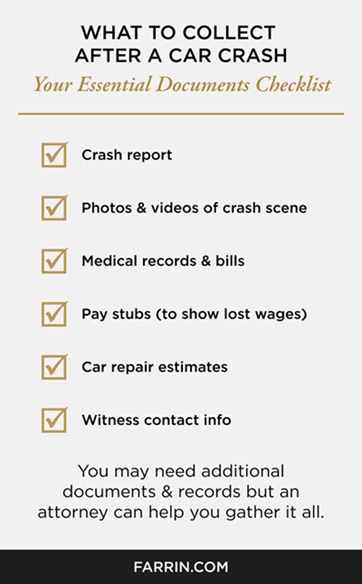
- Keep copies of all medical records, bills, and receipts
Gaps in medical treatment can become ammunition for insurance companies trying to minimize your claim. Consistent care generally shows the true extent of your injuries and can demonstrate that you’re taking your recovery seriously.
Document Everything Related to Your Accident
Evidence has a way of disappearing. Skid marks fade, witnesses forget details, and memories become less reliable over time. The more documentation you gather quickly, the stronger your position can become.
If you took photos or video at the scene, organize them carefully. If you didn’t, consider returning to the location to photograph road conditions, signage, and the general layout — though keep in mind that conditions change. Beyond scene evidence, you should also document:
- Your injuries: Take photos of bruises, cuts, swelling, and any visible injuries as they progress over time
- Your symptoms: Keep a daily journal noting your pain levels, limitations, emotional state, and how injuries affect your daily life
- Financial impacts: Save all receipts related to the accident, including medical bills, pharmacy costs, transportation to appointments, and any equipment you need (crutches, braces, etc.)
- Lost income: If you miss work, document every day lost and get verification from your employer
This paper trail tells the story of how the accident has affected your life. Without it, you’re left relying on memory alone — and that’s rarely as persuasive as hard documentation.
Be Strategic When Communicating With Insurance Companies
Shortly after your accident, you might receive a call from an insurance adjuster. They might sound friendly and concerned, but remember: Adjusters work for insurance companies, and for most their primary goal is to minimize what the company pays out.
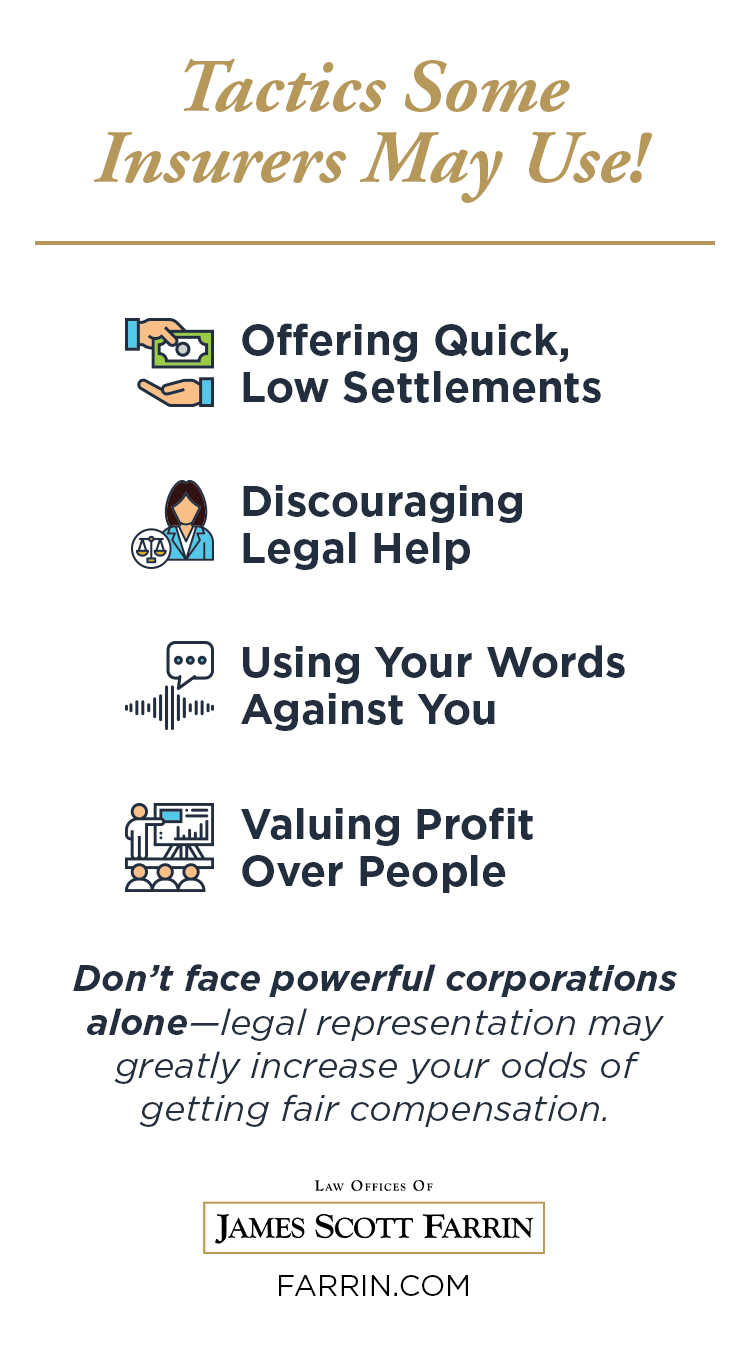
Some insurance companies may use several tactics to reduce settlements:
- Asking for recorded statements that can be used against you later
- Requesting broad authorizations to access your entire medical history (not just accident-related treatment)
- Making quick, lowball settlement offers before you understand the full extent of your injuries
- Using your own words — like “I’m fine” or “I think I’m okay” — to argue your injuries aren’t serious
You’re not required to give a recorded statement to the other driver’s insurance company. Politely decline and explain that you’re still seeking medical treatment. Anything you say can be taken out of context and used to deny or reduce your claim.
When dealing with your own insurance company, stick to the basic facts: the date, time, and location of the accident, and that you’re currently receiving medical treatment. Avoid speculating about fault, discussing your injuries in detail, or accepting any settlement until you’ve fully recovered or understand your long-term prognosis.
The Statute of Limitations in North Carolina
Time limits matter. North Carolina General Statutes section 1-52 says that a civil lawsuit for injury or damage to property must be filed within three years. The clock generally starts running on the date of your accident.
If someone tragically loses their life in the crash, the statute of limitations for filing a wrongful death claim is generally two years from the date of the deceased person’s death, which might be different from the accident date itself.
Missing these deadlines typically means losing your right to pursue compensation through the courts, no matter how strong your case might be. While three years sounds like plenty of time, building a solid case requires investigation, gathering evidence, and sometimes lengthy negotiations. Starting early is highly recommended.

North Carolina’s Current Insurance Requirements
Understanding insurance coverage helps you know what compensation might be available. Starting July 1, 2025, for all new or renewed policies on or after that date, the minimum limits:
- for bodily injury increased to $50,000 per person and $100,000 per accident
- for property damage increased to $50,000
These minimums represent the bare minimum coverage drivers must carry. In a serious accident, medical bills, lost wages, and other damages can quickly exceed these limits. That’s why North Carolina also requires drivers to carry uninsured motorist (UM) and underinsured motorist (UIM) coverage, matching or exceeding the new liability limits. The North Carolina Department of Insurance provides detailed information about these coverage requirements.
If the at-fault driver’s insurance doesn’t cover your full losses, your own UIM coverage might help bridge the gap. Recent changes to North Carolina law have also eliminated the “liability setoff” that previously reduced UIM benefits — meaning accident victims can now potentially collect more from their own policies.
Greensboro’s Most Dangerous Intersections and Roads
Understanding where accidents happen most frequently in Greensboro can help you stay alert — and provide context if you were injured at one of these locations. According to Greensboro police, crash hotspots include Interstate 40 exchanges at Randleman Road, Elm-Eugene Street, and Martin Luther King Jr. Drive, where narrowing lanes create a dangerous mix of congestion and speed.
Historical data also identifies these Greensboro intersections as particularly problematic for drivers:
- Lawndale Drive at West Cornwallis Drive
- East Wendover Avenue at North Church Street
- Lees Chapel Road/North Church Street and Pisgah Church Road
If your accident occurred at or near one of these locations, you’re far from alone. The pattern of crashes at these spots often involves drivers failing to reduce speed when transitioning from highway to non-highway roads or when traffic suddenly congests. This context can be relevant when building your case.
Consider Consulting a Greensboro Car Accident Attorney
When injuries are significant, when fault is disputed, or when insurance companies aren’t treating you fairly, having legal representation can make a substantial difference.
An experienced car accident attorney can:
- Handle communications with insurance companies on your behalf
- Investigate the accident to build a strong case
- Work with medical professionals as needed and any witnesses to document your injuries
- Calculate the full potential value of your claim, including any future medical needs and long-term impacts
- Negotiate aggressively for fair compensation
- Take your case to trial as needed if the insurance company refuses to offer a reasonable settlement
Our personal injury attorneys work on a contingency fee basis, which means you pay no fee unless we recover compensation for you.2 This arrangement removes financial barriers to professional help and lets you focus on what matters most: your health.
Protect Your Legal Rights from Day One
North Carolina has strict legal standards that make protecting your rights from the very beginning essential. Even small mistakes — like admitting any degree of fault at the scene, posting about your accident on social media, or failing to document your injuries properly — can have outsized consequences later.
You should assume from the start that your case might eventually involve legal proceedings, just in case. This means treating every conversation with insurance adjusters carefully, preserving all evidence methodically, and keeping detailed records of everything.
If your case does require legal action, you’ll be grateful for this foundation.
Common Mistakes That Can Hurt Your Case
Even well-meaning accident victims sometimes damage their own cases. Avoid these pitfalls:
- Posting on social media: Some insurance companies may scour social media looking for evidence that your injuries aren’t as serious as you claim. Even innocent posts can be twisted against you.
- Accepting the first settlement offer: Early offers rarely reflect the true potential value of your claim. Once you accept, you generally can’t ask for more — even if your injuries turn out to be worse than expected.
- Failing to follow medical advice: Skipping appointments or ignoring treatment recommendations likely suggests to insurance companies that you’re not really hurt.
- Waiting too long to take action: Evidence disappears, witnesses become harder to locate, and memories fade. Acting promptly helps protect your interests.
- Trying to handle a complex case alone: Insurance companies have teams of lawyers and adjusters. Having professional representation levels the playing field.
Your focus should be on healing. Making mistakes during the claims process can add stress and reduce your potential compensation at a time when you need support most.
FAQs for What to Do After a Car Accident in Greensboro
Car accidents raise many questions, and getting accurate information helps you make better decisions. Here are answers to questions Greensboro residents commonly ask.

 Text Us