

As a workers’ compensation attorney, I know that when you are injured at work, filling out legal forms is usually the last thing on your mind. You are rightfully focused on your health, your family, and securing your next paycheck. I see it all the time: amidst the chaos of medical appointments and recovery, administrative details like deadlines get pushed to the back burner.
Unfortunately, I also know that the workers’ compensation systems in both North and South Carolina run on a strict clock. The hard truth is that if you miss the deadline to file your workers’ comp claim, the consequences can be devastating.

Whenever a potential client calls me in a panic about a missed date, I tell them this: do not give up. While the situation is serious, a missed deadline does not always mean your case is over. In my practice, I have successfully argued for exceptions that allow injured workers to pursue the benefits they may be owed, even when the timeline looks bleak.1
Key Takeaways About What Happens if You Miss the Deadline to File a Workers’ Comp Claim
- Workers’ compensation systems in North Carolina and South Carolina have strict time limits for reporting injuries and filing claims.
- Missing a deadline can potentially bar an injured worker from receiving benefits.
- There are two primary deadlines: one for notifying the employer and another for filing a formal claim with the state.
- Certain exceptions can sometimes extend these deadlines, but they are complex and fact-specific.
- An attorney can evaluate the circumstances surrounding a missed deadline to determine if any options remain.
The Two Critical Workers’ Comp Deadlines
Many people I talk to think there is only one “deadline” for workers’ compensation, but in reality, there are two major time limits you must meet. Confusing these two can jeopardize your entire claim before it even begins. And North Carolina and South Carolina have their own specific rules.
The Deadline to Notify Your Employer
The clock starts ticking the moment you are injured. This first deadline is for giving notice of your injury to your employer. Think of this as the official start of the process, letting your company know that a work-related injury or illness has occurred.
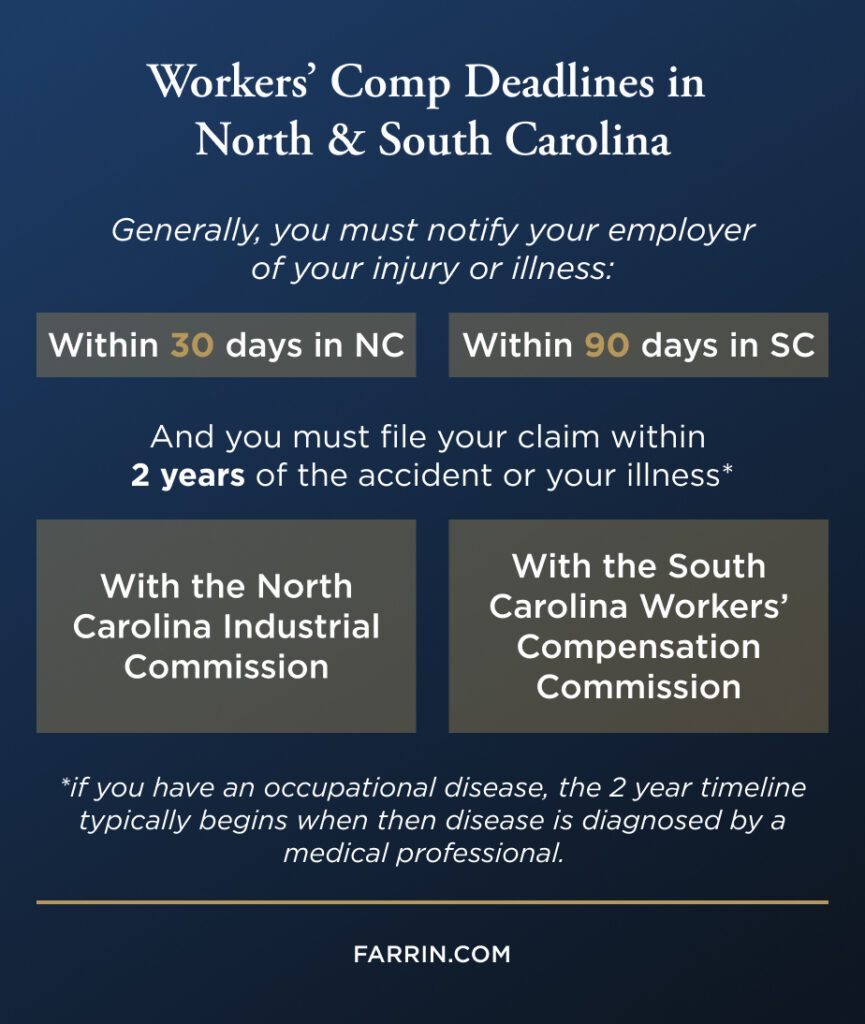
- In North Carolina, you generally must notify your employer of your injury within 30 days. According to the North Carolina General Statute § 97-22, this notice should ideally be in writing. While verbal notice might sometimes be accepted, a written report creates a clear record that is much harder for an employer or their insurance company to dispute later.
- In South Carolina, the rule is a bit more generous. South Carolina Code § 42-15-20 gives an injured employee 90 days to provide notice of an injury to their employer. Like in NC, written notice is always the recommended path.
Failing to meet this initial deadline can give the insurance company an immediate reason to question or deny your claim.
The Deadline to File Your Formal Claim
Giving notice to your employer is only step one. The second, and final, deadline is for filing a formal claim with the state agency that oversees workers’ compensation. This is the official legal filing that seeks benefits.
- In North Carolina, you generally must file a claim with the North Carolina Industrial Commission (using a Form 18) within two years of the date of the accident. This is a strict statute of limitations, which is a law that sets a firm time limit for taking legal action.
- In South Carolina, the rule is the same and you must file a claim with the South Carolina Workers’ Compensation Commission. You generally have two years from the date of the injury to file your claim (using a Form 50 or Form 52) with the South Carolina Workers’ Compensation Commission.
This two-year deadline is a hard stop for most claims. If you miss it without a legally recognized exception, your right to seek benefits is likely lost forever.
The Serious Consequences of a Missed Deadline When Filing a Workers’ Comp Claim
I want to be direct about what’s at stake, not to cause worry, but to stress the importance of these timelines. When an insurance company sees that a deadline has been missed, they often deny the claim outright. They are not required to consider the circumstances or give you the benefit of the doubt. For them, a missed deadline is usually a clear and simple reason to close the file.
This can mean you are left to personally cover all costs associated with your work injury. The possible outcomes include:
- No payment for medical bills – All of the costs for your doctor visits, surgeries, physical therapy, and prescription medications could become your personal responsibility.
- No compensation for lost wages – The weekly checks that could replace a portion of your income while you are unable to work would not be available.
- No eligibility for a permanency award – If your injury results in a permanent impairment, you could be barred from receiving a settlement for that loss.
The financial strain from a denied claim can be immense, which is why acting promptly after a work injury is so critical.
Are There Any Exceptions to These Deadlines?
Now for the crucial question: if you’ve already missed a deadline, is there anything you can do? The answer is a qualified “possibly.” The law recognizes that certain situations can prevent a person from filing on time. However, proving that one of these exceptions applies to your case is a complex legal battle. This is where an experienced attorney’s guidance can be invaluable.
When the Employer or Insurer Misleads You
Sometimes, an employer or their insurance representative might say things that cause you to delay filing. They might tell you, “We’ll take care of everything,” or “You don’t need to file any paperwork, we’ll pay the bills.” If you relied on these statements and missed the deadline as a result, you might be able to use a legal argument called “equitable estoppel.”
In simple terms, this argument says it would be unfair for the insurance company to use the deadline against you when their own actions caused you to miss it. To make this argument, you typically need to show that you were misled and that you reasonably relied on that misleading information.
The “Discovery Rule” for Certain Injuries
Not all work injuries are the result of a single, sudden event like a fall. Some develop slowly over time due to the nature of your job. These are often called “occupational diseases.” Examples include:
- Carpal tunnel syndrome from years of repetitive hand movements
- Lung conditions from long-term exposure to dust or chemicals
- Hearing loss from working in a loud environment, like a factory in Greenville or a construction site near the Raleigh Beltline
For these types of conditions, the filing clock might not start ticking on your last day of work. Instead, under the “discovery rule,” the two-year deadline would likely begin on the date that a doctor diagnoses your condition and informs you that it is likely related to your job. This can be a critical exception for people who endure health problems for years before connecting them to their work.
The Employer Already Knew About the Injury
This exception primarily applies to the initial 30-day (in NC) or 90-day (in SC) notice period. If your supervisor witnessed your accident, drove you to the emergency room, or was otherwise directly aware that you were hurt at work, it can be argued they had “actual knowledge” of the injury.
This actual knowledge can sometimes excuse your failure to provide a formal written notice within the required timeframe. However, it does not excuse the two-year deadline for filing a formal claim.
Technical and Other Potential Exceptions
There are a few other, less common situations that might extend a deadline. These arguments are highly technical and depend heavily on the specific facts of your case.
- Minority or Incompetence: If the injured worker is a minor (under 18), the statute of limitations is often paused, or “tolled,” until they reach the age of 18. A similar principle can apply if a person is legally declared incompetent to handle their own affairs.
- Employer’s Failure to Post Notices: By law, employers are required to post notices in the workplace informing employees of their workers’ compensation rights. While a difficult argument to win, some cases have successfully argued that an employer’s failure to post this notice should extend the filing deadline.
- Payment of Wages or Medical Care: In some very specific circumstances, an employer voluntarily paying for your medical treatment or continuing your salary in place of disability benefits might be interpreted as an admission of responsibility, which can potentially extend the two-year filing deadline. This is a very nuanced legal point that is not guaranteed to succeed.
These potential exceptions are not loopholes to be taken lightly; they are complex legal arguments that an insurance company will fight vigorously.
Why You Shouldn’t Make the Call on Your Own
After reading about these exceptions, you might be trying to decide if one applies to you. I strongly recommend that you do not make this determination on your own. The insurance adjuster you speak with works for the insurance company. Their goal is often to close your claim for as little money as possible. They are not obligated to inform you about potential exceptions that could save your claim.
Evaluating whether a missed deadline can be excused requires a deep understanding of state laws and past court decisions. An experienced workers’ compensation attorney can:
- Listen to your complete story and ask the right questions
- Analyze your documents, emails, and medical records for key evidence
- Try to identify any statements or actions by your employer that might support an exception
- Build a compelling legal argument to present to the commission
Think of it this way: when you have a serious medical issue, you see a professional for an accurate diagnosis. When you have a serious legal issue, the principle is the same. Let a professional who handles these cases every day evaluate your situation.
Steps to Take if You Think You’ve Missed a Deadline
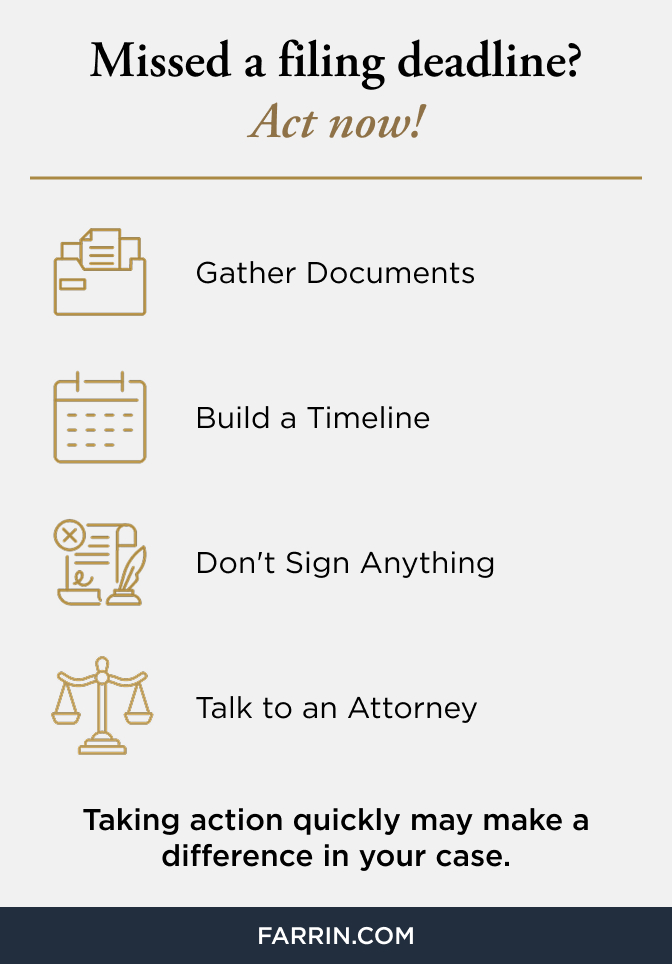
If you are worried that you’ve missed a deadline, it is critical to act immediately. Do not delay any further. Here are four practical steps you can take right now to help protect any rights you might still have.
- Gather your documents. Collect every piece of paper you can find related to your injury. This includes medical records, bills, accident reports you might have filled out, and any letters or emails from your employer or their insurance company.
- Write down a timeline. As best you can, create a detailed timeline of events. Start from the day of the injury and include every conversation with your boss, HR, or an adjuster. Note who you spoke to, the date, and what was said.
- Do not sign anything. The insurance company might send you documents to sign, such as a medical release or a recorded statement authorization. Do not sign anything or agree to give a recorded statement until you have spoken with an attorney.
- Contact an attorney immediately. Get a free professional legal opinion.
Taking these organized steps can provide an attorney with the information they need to quickly and accurately assess your case.
FAQs for if You Miss the Deadline to File a Workers’ Comp Claim
Here are answers to some common questions I often hear from injured workers about workers’ compensation deadlines.
 Text Us