

If you’ve been hurt on the job, your mind is likely racing with questions. How will I pay my medical bills? What about my lost wages? And perhaps the most confusing question of all is, what kind of legal claim do I have?
As a workers’ compensation attorney licensed in both North and South Carolina, I often speak with people who are trying to figure out the difference between workers’ comp vs. personal injury claims. While both types of claims involve an injury, they are fundamentally different legal paths with different rules, processes, and potential outcomes.

The choice is not always clear, and in some cases, you might even be able to pursue both. Let’s break down these two types of claims so you can have a clearer picture of your options.
Key Takeaways About Workers’ Comp vs. Personal Injury Claims
- Workers’ compensation is a no-fault system, meaning an injured employee generally does not have to prove their employer was negligent to receive benefits.
- A personal injury claim is based on fault, requiring the injured person to prove that another party’s negligence caused their injuries.
- Benefits in workers’ compensation are typically limited to medical treatment, a portion of lost wages, or disability while personal injury damages can also include compensation for pain and suffering.
- It is sometimes possible for an injured worker to have both a workers’ compensation claim and a personal injury claim if a third party (someone other than their employer or a co-worker) was responsible for the injury.
- The legal processes and deadlines for filing workers’ comp and personal injury claims are very different and are governed by separate state laws.
What Is a Workers’ Compensation Claim?
Workers’ compensation is a type of insurance that most employers in the Carolinas are required by law to carry if they have at least 3 (in NC) or 4 (in SC) employees. It is designed to provide specific benefits to eligible employees who get injured or become ill as a direct result of their job duties. Think of it as a trade-off – in exchange for these potential benefits, employees generally cannot sue their employer for a workplace injury.
The most important feature of the workers’ compensation system is that it is a “no-fault” system. This means that, in most cases, it doesn’t matter who was at fault for your injury. Whether you tripped over your own feet or a piece of equipment malfunctioned, you are likely eligible for benefits as long as the injury occurred while you were performing your job.
The North Carolina Workers’ Compensation Act and South Carolina’s workers’ compensation laws outline the specific rules for employers and employees in each state.
What Benefits Does Workers’ Comp Provide?
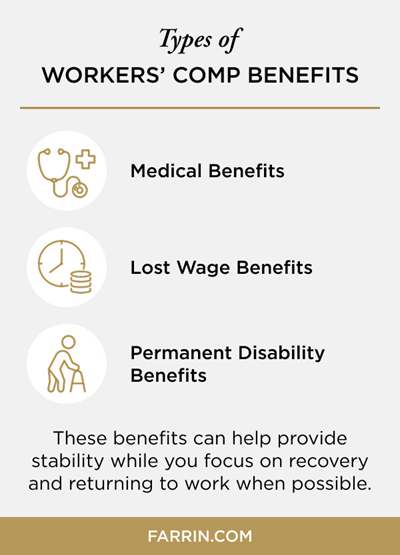
The benefits are set by state law and are generally limited to a few specific categories. While the exact details can vary, workers’ comp benefits typically include:
- Medical Treatment: This covers necessary medical care related to the work injury, including doctor visits, hospital stays, surgery, medication, and physical therapy.
- Wage Replacement Benefits: If your injury prevents you from working, workers’ comp can provide payments to replace a portion of your lost wages (usually about two-thirds of your average weekly wage).
- Permanent Disability Benefits: If your injury results in a permanent impairment, you may be eligible for additional compensation based on the nature of the disability and the body part affected.
These potential benefits are intended to help you recover and get back on your feet financially without having to go through a lengthy court battle to prove that your employer did something wrong.
What Is a Personal Injury Claim?
A personal injury claim is a legal action you can take when you are harmed by someone else’s carelessness or intentional act. Unlike workers’ comp, a personal injury claim is entirely based on the concept of fault. To have a successful claim, you and your attorney must prove that another person or entity was negligent.
Negligence is a legal term for when someone fails to act with reasonable care, and that failure causes harm to another person. For example, a driver who runs a red light and causes a crash has likely acted negligently. A store owner who knows about a spill on the floor but fails to clean it up, leading to a customer’s fall, has also generally acted negligently.
What Kind of Compensation Might I Get in a Personal Injury Claim?
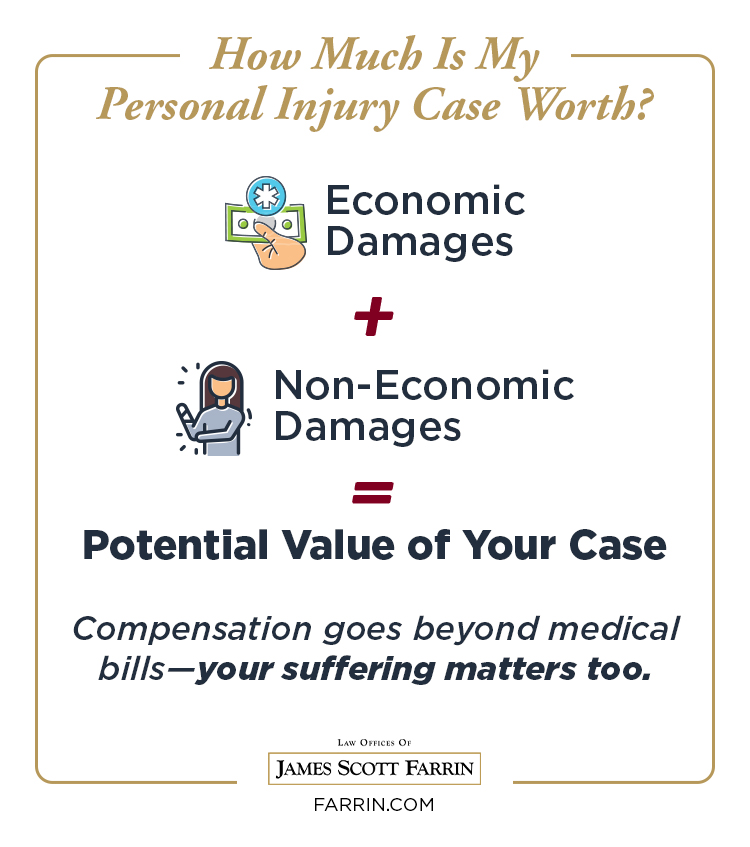
If you can prove the other party was at fault, you may be able to recover compensation for a range of harms and losses, often called “damages.” These can be separated into two main types:
- Economic Damages: These are the measurable financial losses you may have endured because of the injury. This category can include things like all of your past and future medical bills, all of your past and future lost income, and other out-of-pocket expenses.
- Non-Economic Damages: These are losses you may have suffered that don’t have a specific price tag but are just as real. They can compensate you for the human cost of the injury, such as physical pain, emotional distress, scarring or disfigurement, and loss of enjoyment of life.
Because it can include compensation for pain and suffering, the potential financial recovery from a personal injury claim can sometimes be greater than what is available through workers’ compensation. At my firm, we have experienced personal injury attorneys who consult with our workers’ comp team to help examine all possible options for our clients.
The Core Differences: A Side-by-Side Look
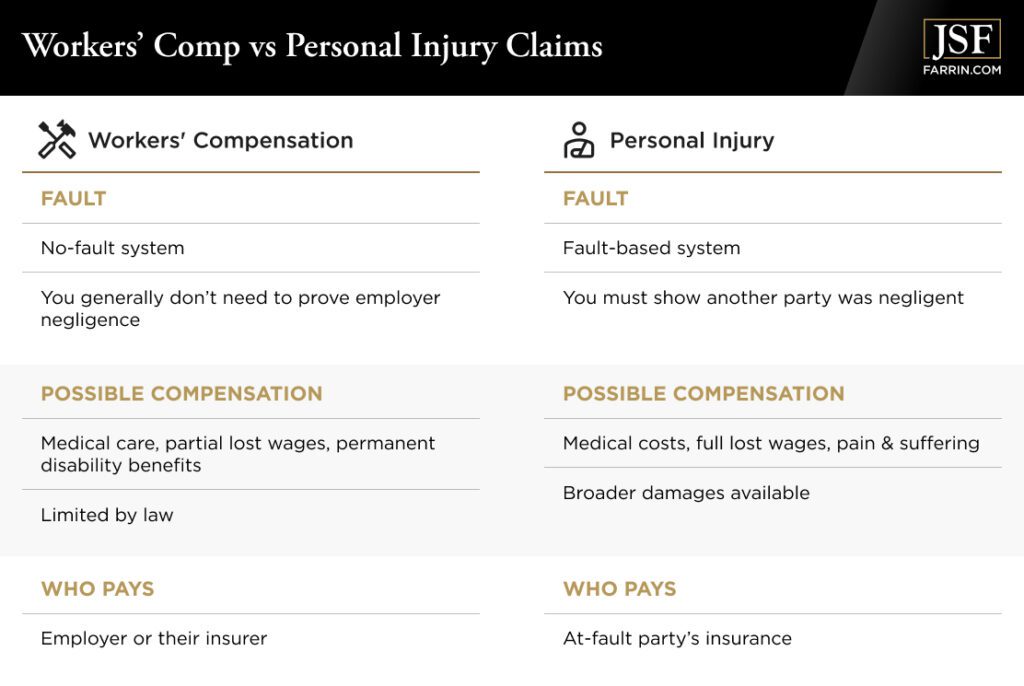
It can be helpful to see the main distinctions between these two types of claims laid out clearly.
The Role of Fault
The biggest difference is fault.
- Workers’ Compensation:No-fault. You generally do not need to prove your employer was careless to get benefits.
- Personal Injury:Fault-based. You must prove that another party was negligent and that their negligence directly caused your injury.
Types of Compensation Available
The money you might receive is also very different.
- Workers’ Compensation: Potential benefits are defined by law and are limited to medical care, a percentage of lost wages, and disability payments. There is no compensation for pain and suffering.
- Personal Injury: Potential damages are much broader and can include medical costs, all lost wages, and compensation for pain, suffering, and other non-economic losses.
Who Pays for the Damages?
The source of potential payment is another key distinction.
- Workers’ Compensation: Benefits are potentially paid by your employer or their workers’ compensation insurance company.
- Personal Injury: Compensation is typically paid by the at-fault party’s liability insurance company (for example, a car insurance or commercial liability policy).
The different approaches to fault and compensation make these two legal avenues very distinct, each with its own set of rules, deadlines, and procedures.
Can I Have Both a Workers’ Comp and a Personal Injury Claim?
This is a question I hear often, and the answer is: in certain situations, yes. While you generally cannot sue your employer if you are covered by workers’ compensation, you may be able to file a personal injury claim against a negligent third party who caused your on-the-job injury. A “third party” is someone other than your employer or a co-worker.
This scenario, known as a third-party liability claim, creates an opportunity to pursue compensation beyond what workers’ comp offers. Here are a few common examples where this might happen:
- A Car Accident While on the Clock: Imagine you are a Greensboro, NC delivery driver, and while making a delivery, another driver runs a stop sign and crashes into your van. You can file a workers’ compensation claim because you were hurt while working. You might also file a personal injury claim against the at-fault driver to seek compensation for your pain and suffering.
- Defective Equipment: A construction worker on a job site in Raleigh, NC might be using a power tool that has a manufacturing defect. If the tool malfunctions and causes a serious injury, the worker could have a workers’ comp claim as well as a personal injury claim (a “product liability” claim) against the tool’s manufacturer.
- An Injury on Someone Else’s Property: An electrician sent to a commercial property in Greenville, SC, could trip and fall on a broken, unmarked stairwell while on the job. They would likely have a workers’ comp claim through their employer and might also have a personal injury claim (a “premises liability” claim) against the owner of the property for failing to maintain a safe environment.
Pursuing both types of claims can be legally complex. For instance, the workers’ compensation insurance carrier will often place a lien on any recovery from the personal injury case, meaning they have a right to be paid back for the benefits they provided. An experienced attorney can address these liens and fight to put the maximum settlement or verdict amount in your pocket.
Why the Distinction Matters for Your Recovery
Recognizing whether you have a workers’ comp claim, a personal injury claim, or both is essential. If you only pursue a workers’ compensation claim when a third party was at fault, you could be leaving significant compensation on the table — money that could account for the full scope of your harms, including your pain and suffering. On the other hand, trying to file a personal injury lawsuit when workers’ compensation is your sole remedy could lead to a dismissed case and wasted time.
The deadlines for filing are also strict and different for each type of claim. Missing a deadline could mean losing your right to pursue compensation entirely. This is why it is so important to understand your legal options as soon as possible after a work-related injury.
A workers’ compensation attorney can evaluate the specific facts of your situation and advise you on the appropriate path forward.
FAQs for Workers’ Comp vs. Personal Injury Claims
Here are some answers to other common questions people have when they are injured on the job.
 Text Us