


How Do Auto Accident Claims Settlements in NC Work?
Auto accident claims settlements in North Carolina work by having the injured person (or their attorney) negotiate with the at-fault driver’s insurance company to reach a monetary agreement that resolves the claim without going to court.
As an NC car accident lawyer, I have helped many car accident victims settle their car accident claims.1 This process involves gathering evidence of the accident and the injuries, calculating all the related costs, and formally demanding compensation before entering into back-and-forth negotiations with an insurance adjuster.
To answer the question of “How do auto accident claims settlements in NC work?” I will explain the key phases of the process and what steps may be necessary to protect your rights.
If you’ve been harmed by a negligent driver, call James Scott Farrin today for a free case evaluation at 1-866-900-7078.
Key Takeaways for NC Auto Accident Claim Settlements
- A settlement is a negotiated agreement between an injured party and an insurance company to resolve a personal injury claim.
- The value of a settlement is based on evidence, including medical records, proof of lost wages, and the severity of the injuries.
- North Carolina has very strict laws regarding fault, which can significantly impact a person’s ability to recover compensation.
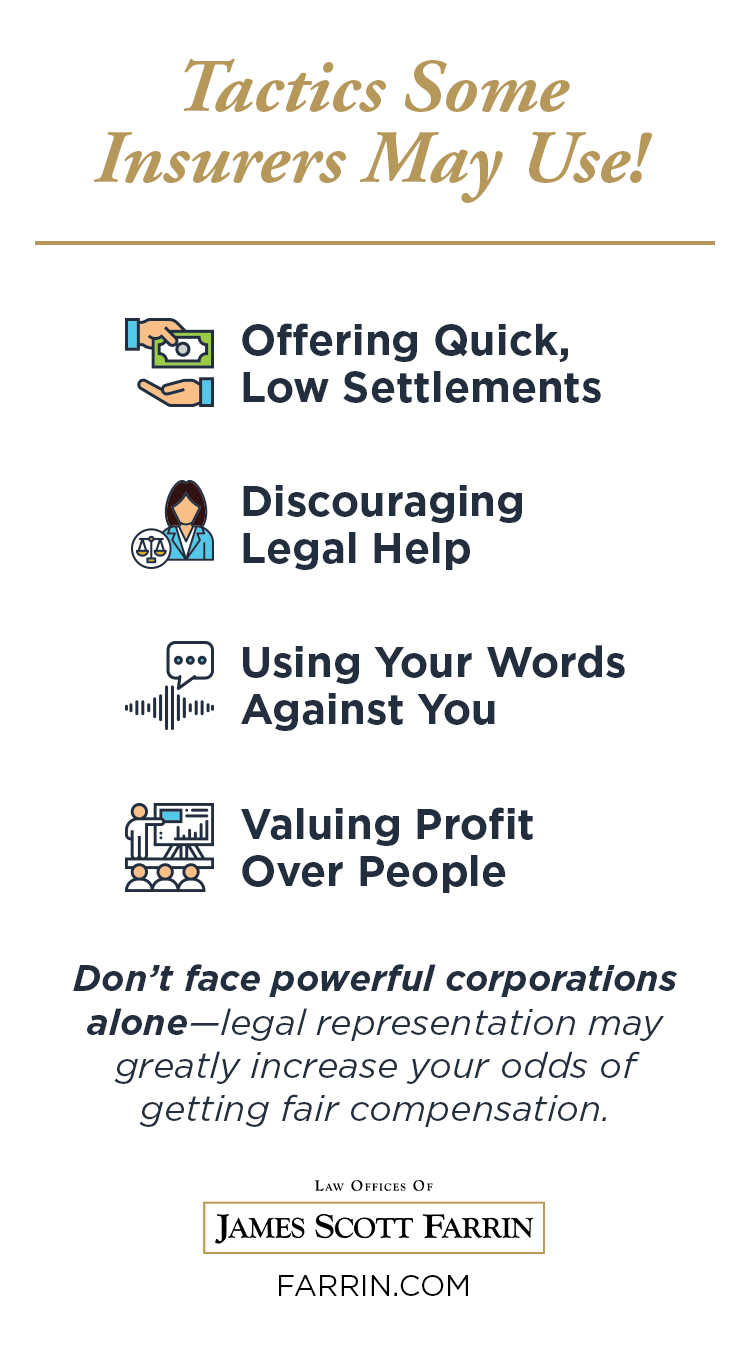
- Insurance companies often try to settle claims for the lowest amount possible to protect their bottom line.
- An experienced attorney handles communications, evidence gathering, and negotiations on behalf of the client.
- Hiring a car accident attorney can significantly increase the odds of a more favorable outcome in a settlement negotiation.
What Is an Auto Accident Settlement?
An auto accident settlement is a formal agreement that ends your potential injury claim. In exchange for an agreed-upon amount of money, you sign a legal document — called a release — that prevents you from taking any further legal action against the at-fault party for that specific accident.
The majority of successful car accident cases in North Carolina are resolved through settlements rather than a full trial in court. This is often because a settlement provides a definite outcome, while a trial can be unpredictable for both sides. The settlement process is a negotiation, with your side trying to prove the full value of your harms and losses and the insurance company often trying to minimize what they pay.
The Auto Accident Claim Settlement Process in North Carolina
While every case is different, the path to a potential settlement generally follows a series of predictable steps. I guide my clients through this journey, managing the legal complexities so they can focus on their health and recovery.
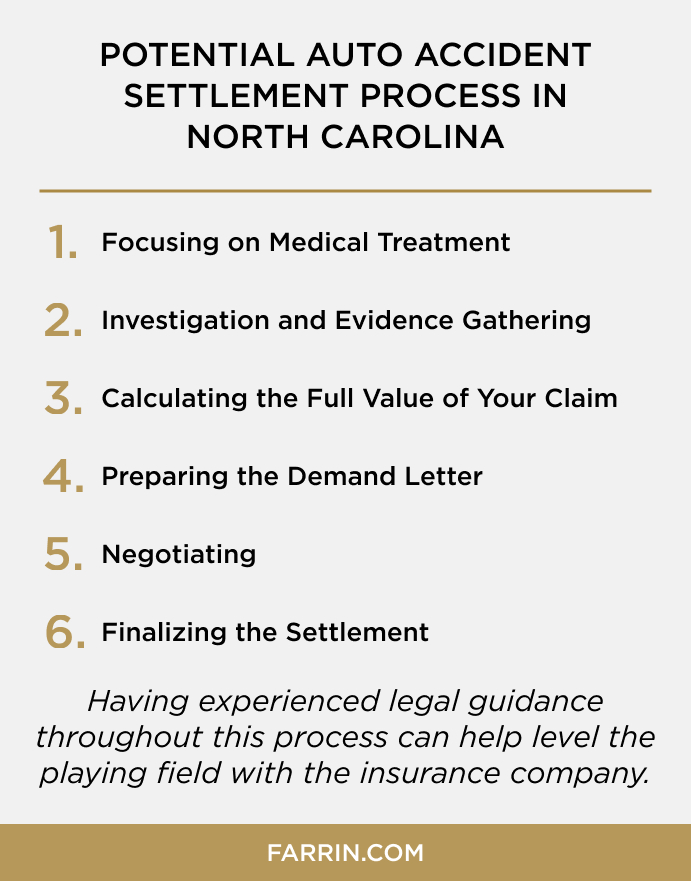
Step 1: Focusing on Medical Treatment
After you have left the accident scene, your top priority should be your health. Following your doctor’s treatment plan is not only crucial for your physical recovery but also for your legal claim.
- Documentation Is Key: Every doctor’s visit, physical therapy session, and medical procedure creates a record. These records are essential evidence that can directly link your injuries to the accident.
- Following Medical Advice: Adhering to your doctor’s orders can demonstrate the seriousness of your injuries. Gaps in treatment or failing to follow advice can be used by an insurance company to argue that your injuries aren’t as severe as you claim.
- Maximum Medical Improvement: We typically wait until you are fully healed before trying to negotiate a settlement. Waiting allows us to understand the full, long-term potential cost of your injuries.
It is only after we have a complete picture of your medical journey that we can begin to calculate the potential value of your claim.
Step 2: Investigation and Evidence Gathering
While you are healing, the behind-the-scenes work of building your case begins. A compelling claim is built on a foundation of solid evidence. Our goal is to gather the information needed to paint a clear picture of what happened and how it has impacted your life.
This phase may involve:
- Obtaining the official police report from the responding agency
- Collecting and preserving photos and videos from the accident scene
- Identifying and interviewing any witnesses to the crash
- Gathering all your medical bills and records from every provider you have seen
- Requesting documentation from your employer to prove your potential lost wages and time away from work
In more complex cases, such as a major pile-up on I-40 or a commercial truck accident, we may even work with investigators to reconstruct the accident scene, if needed, to try to establish that the at-fault driver was negligent.
Step 3: Calculating the Full Value of Your Claim
Once we have collected the evidence and you have completed healing, we can estimate the fair potential value for your claim. Potential compensation in a North Carolina car accident claim is generally broken down into two main categories of damages.
First, there are economic damages, which are the tangible financial losses you may have endured. These are the costs that have a clear price tag, such as:
- Past and future medical expenses
- Lost wages and lost earning capacity
- Property damage to your vehicle
- Other out-of-pocket costs related to the accident
Second, there are non-economic damages, which can compensate you for intangible personal harms and losses. These are more subjective, but they are just as real and can have a profound impact on your life.
- Pain and physical hardship
- Emotional distress and mental anguish
- Scarring and disfigurement
- Loss of enjoyment of life
It takes experience and careful consideration to determine potential damages because there is no set formula or calculation to follow. We analyze past case results, the severity of your injuries, and the possible long-term effects on your life to arrive at a potential settlement range that we believe is fair.
Step 4: Preparing the Demand Letter
With a valuation in hand, we prepare and send a formal “demand package” to the at-fault driver’s insurance company on behalf of our client. This is much more than just a letter asking for money. It is a comprehensive, professional presentation of your case.
The demand package typically includes:
- A letter that outlines the facts of the accident, argues the other driver’s fault, and details your injuries
- A breakdown of all the economic and non-economic damages you may have experienced, potentially concluding with a specific monetary demand for a settlement
- Supporting documentation, such as the police report, key medical records, medical bills, and proof of lost income
This package can kick off the negotiation phase. After reviewing it, the insurance adjuster will generally respond with a much lower counter offer.
Step 5: Negotiating
This is where having a skilled advocate can make a significant difference. The insurance adjuster’s job is often to protect the company’s bottom line and settle your claim for as little as possible. They are trained negotiators who handle these claims every day.
The negotiation process is a strategic back-and-forth conversation.
- Countering Lowball Offers: Any first offer is almost always low. We will analyze the potential offer, point out any flaws in their reasoning, and re-emphasize the strengths of your case based on the evidence.
- Pushing Back Against Delays: Some insurance companies may use delay tactics, hoping you will get frustrated and accept a low offer. We fight to keep your case moving forward by constantly following up and applying pressure as needed.
- Fighting for You: We handle communications with the adjuster. You won’t have to worry about saying the wrong thing or feeling pressured into a decision. We advise you at every step, but the final decision to accept or reject an offer is always yours.
Most successful cases are settled during this phase. However, if the insurance company refuses to make a fair offer, the next step may be to file a car accident lawsuit if needed.
Step 6: Finalizing the Settlement
If we reach a settlement agreement that you approve, the final steps are straightforward. The insurance company will send a settlement and release agreement for you to sign. This document generally states that you accept the settlement amount as full payment for your claim and release them from all future liability.
Once you sign any release, we will send it back to the insurance company, and they can issue a potential settlement check. We can then address any outstanding medical bills or health insurance liens from that check before disbursing remaining funds to you.
Critical Factors That Can Influence Your NC Settlement
Several key factors can significantly affect the amount of your potential auto accident claim settlement in NC.
The Severity of Your Injuries
The nature and extent of your injuries are often the biggest drivers of a potential settlement’s value. A case involving a catastrophic injury, such as a spinal cord or traumatic brain injury, will have a much higher potential settlement value than a case with minor soft-tissue injuries. This is because severe injuries typically involve more extensive medical treatment, longer recovery times, greater lost income, and a more profound impact on your quality of life.
Establishing Who Was at Fault
To have a successful injury claim, we must clearly establish that the other driver’s actions caused the accident. The at-fault driver’s insurance company is the one likely responsible for paying damages, so proving their policyholder’s fault is the foundation of your case.
However, determining fault isn’t always straightforward. The other driver’s insurance company will conduct its own investigation. Some insurers may find reasons to shift the blame or create doubt about what happened in order to reduce or deny the claim.
This is a critical area where an attorney can help protect your claim. We work to build a compelling case based on evidence to try to clearly demonstrate the other party’s negligence. This generally involves analyzing the police report, gathering witness statements, and, when needed, working with accident reconstruction experts to show exactly how the crash occurred. A strong presentation of fault is the foundation upon which the rest of your potential settlement negotiation can be built.
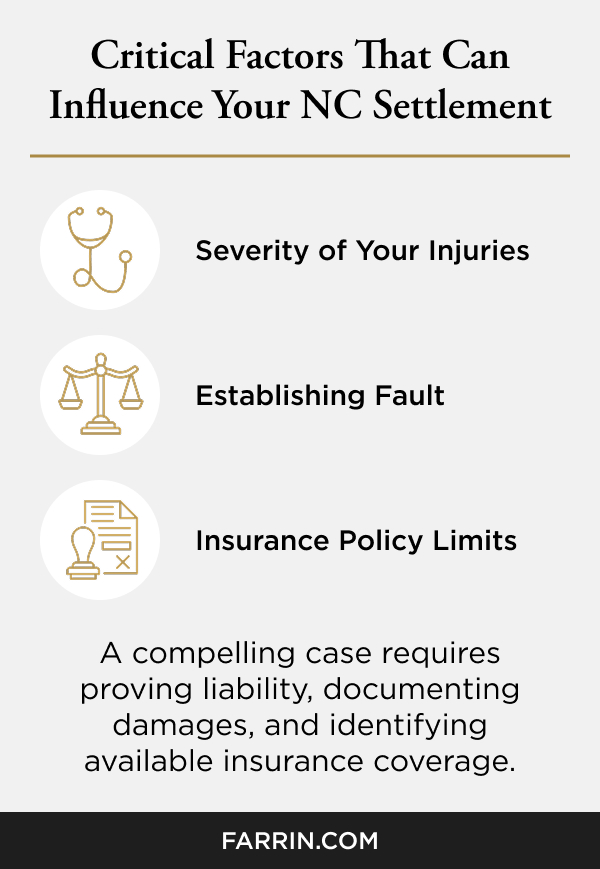
Insurance Policy Limits
No matter how severe your injuries are, you generally cannot recover more than the limits of the at-fault driver’s insurance policy. For example, if your damages total $100,000 but the at-fault driver only has a $30,000 liability policy, their insurance company will only pay up to $30,000.
This is where your own insurance policy can be a lifeline. If you have Underinsured Motorist (UIM) coverage, we may be able to file a claim with your own insurance company to help cover the difference.
North Carolina law recently changed regarding the amount of insurance policy limits and how it works, so it is important to discuss these issues with an attorney.
Frequently Asked Questions About NC Auto Accident Settlements
Here are answers to some of the common questions I hear from clients going through this process for the first time.
 Text Us