

Construction work is the engine of progress in North Carolina. From the cranes reshaping the skylines in Charlotte and Raleigh to the crews building homes in growing communities, your hard work builds our future. But this physically demanding job comes with serious risks. The most common construction injuries in North Carolina mirror those in other states across the country. When these accidents occur, the consequences can be life-altering.
If you’ve been injured in a construction accident, you’re likely facing medical bills, lost wages, and concerns about what comes next. Fortunately, the North Carolina workers’ compensation system is designed to help most injured workers, but knowing your rights is crucial to accessing potential benefits.
Key Takeaways About the Most Common Construction Injuries in North Carolina
- Construction is a high-risk industry, with falls, struck-by incidents, electrocutions, and caught-in/between accidents being major causes of injury.
- The North Carolina Workers’ Compensation Act provides benefits to most injured construction workers, regardless of who was at fault.
- Workers’ compensation benefits typically include medical treatment, wage replacement, and compensation for any permanent impairment.
- In some cases, an injured worker might have a third-party liability claim against a negligent party other than their employer, such as a subcontractor or equipment manufacturer.
- Reporting an injury promptly and seeking immediate medical attention are critical first steps for an injured construction worker.
The Dangers Present on a North Carolina Construction Site
Construction sites are dynamic environments filled with heavy machinery, heights, and powerful tools. While safety regulations exist to minimize risks, accidents still happen. The Occupational Safety and Health Administration (OSHA) identifies a group of hazards responsible for a majority of fatalities in the industry, often called the “Focus Four.” These same hazards are also behind many of the most common construction worker injuries in North Carolina.
These dangers include:
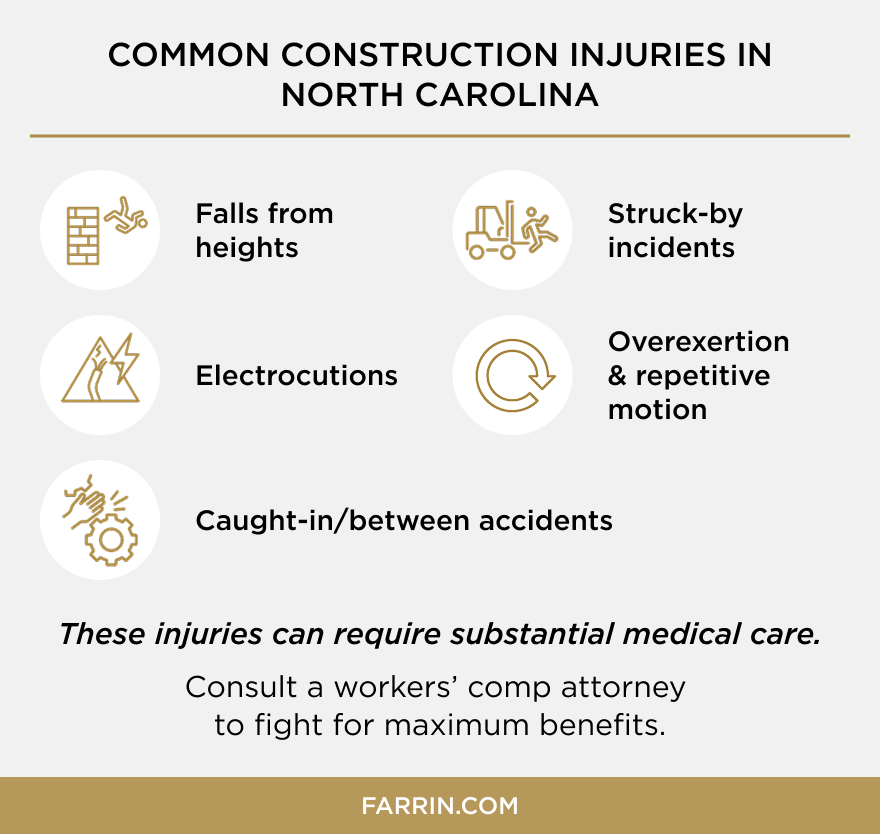
- Falls from heights
- Struck-by object incidents
- Electrocutions
- Being caught-in or between objects/machinery
These primary risk areas help illustrate how quickly a normal workday can turn into a crisis.
The Most Common Construction Injuries in North Carolina
While any number of injuries can occur on a job site, some types are seen more frequently than others due to the nature of the work.
Falls From Heights
Falls are consistently one of the leading causes of serious injury and death in the construction industry. In North Carolina, with multi-story buildings and infrastructure projects constantly underway, workers are often required to operate from significant heights. A fall from a ladder, scaffolding, roof, or an unfinished structure can result in catastrophic harm.
Injuries from these falls often include:
- Traumatic Brain Injuries (TBIs): These can range from concussions to severe brain damage with long-term cognitive and physical effects.
- Spinal Cord Injuries: Damage to the spinal cord can lead to partial or full paralysis, changing a person’s life forever.
- Broken Bones: Multiple fractures are common, requiring extensive surgery and rehabilitation.
These injuries can require a lifetime of medical care and prevent a worker from returning to their trade.
Struck-By Incidents
A busy construction site is a flurry of activity. Struck-by incidents happen when a worker is hit by a moving, swinging, or falling object. This can involve anything from a dropped tool or piece of building material to a swinging crane load or a piece of heavy equipment like a forklift. The force involved in these impacts can be immense, leading to severe injuries. Common examples include crushing injuries to limbs, internal organ damage, and serious head trauma.
Electrocutions
Construction sites are filled with electrical hazards, from temporary wiring and overhead power lines to generators and power tools. Contact with an electrical current can cause devastating injuries. Electrocution can result in severe burns, damage to internal organs, nerve damage, and cardiac arrest. Even a non-fatal shock can cause a worker to fall from a height, leading to a secondary set of injuries.
Caught-In/Between Accidents
These serious accidents occur when a worker is squeezed, crushed, or caught in or between objects. This can happen in a variety of ways:
- A limb getting pulled into unguarded machinery
- A worker being pinned between a vehicle and a wall
- The collapse of a trench or excavation that buries a worker
The resulting injuries are often catastrophic, including amputations, asphyxiation, and severe crush injuries that can damage bones, organs, and soft tissue.
Overexertion and Repetitive Motion Injuries
Not all common construction injuries in North Carolina happen in a single, dramatic moment. The daily grind of lifting, carrying, bending, and using vibrating tools can take a toll on the body.
Overexertion from lifting something too heavy can cause back or shoulder injuries. Repetitive motion, such as swinging a hammer all day, can lead to conditions like carpal tunnel syndrome or tendinitis. These injuries can be just as debilitating as those from a sudden accident and can also be covered by workers’ compensation.
What Are Your Rights After a Construction Injury in North Carolina?
If you’ve been hurt on a construction job, you have rights. The primary system designed to try to help you is workers’ compensation, but in some situations, other legal avenues might also be available.
The North Carolina Workers’ Compensation System
North Carolina law requires most employers to carry workers’ compensation insurance. This system is designed to provide benefits to most employees who are injured on the job. A key aspect of workers’ compensation is that it is a “no-fault” system.
This means you generally do not have to prove that your employer did something wrong to cause your injury; you only need to show that the injury arose out of and in the course of your employment.
Under the North Carolina Workers’ Compensation Act, an injured worker may be able to receive several types of benefits:
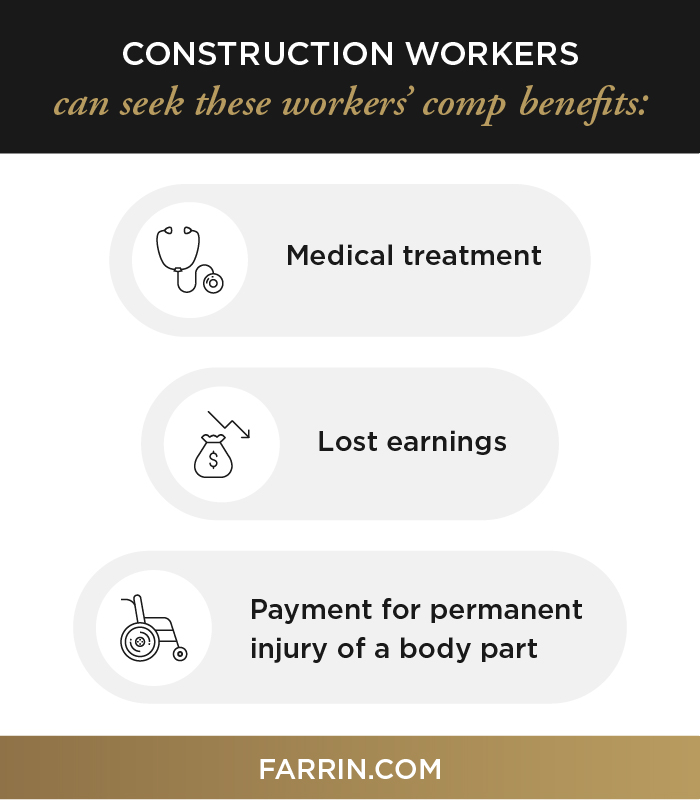
- Medical Benefits: This can cover necessary medical treatment related to the workplace injury, including doctor visits, hospital stays, surgery, prescription medications, and physical therapy.
- Wage-Replacement Benefits: If your injury forces you to miss time from work, you may be entitled to receive a portion of your average weekly wages. These are called temporary total disability (TTD) or temporary partial disability (TPD) benefits.
- Permanent Disability Benefits: If your injury results in a permanent impairment, such as the loss of a limb or reduced function of a body part, you may receive additional compensation based on the state’s rating system.
These potential benefits are intended to help you manage the financial and medical challenges while you recover. The system is managed by the North Carolina Industrial Commission, which is the state agency that administers the workers’ compensation laws.
What About Third-Party Liability Claims?
In some construction accident cases, someone other than your employer or a co-worker (i.e. a “third party”) might be responsible for your injury. When a third party’s negligence causes your injury, you may be able to file a personal injury lawsuit against them in addition to your workers’ compensation claim.
Examples of potentially liable third parties on a construction site include:
- A general contractor or property owner who failed to maintain a safe worksite
- A subcontractor whose employee acted negligently and caused your accident
- The manufacturer of a defective tool or piece of equipment that failed
- An architect or engineer who made a critical design error
- A driver who is not your co-worker hits you while you are working near a road
A third-party claim is different from a workers’ compensation claim. It allows you to pursue compensation for damages that workers’ comp does not cover, such as pain and suffering. Investigating whether a third party shares fault for your injury can be complex, but an experienced attorney can help you gather evidence and build your case.
Steps to Take After a Construction Injury
After seeking emergency medical care, the actions you take can be crucial for protecting your health and your legal rights. Once you are home and able to do so, consider the following steps.
- Report the Injury in Writing: Notify your supervisor of your injury as soon as possible. While you have 30 days to provide a verbal notice, it is recommended to report it in writing so there is a clear record of when and how the injury was reported.
- Get Prompt Medical Attention: Even if you think your injury is minor, see a doctor. Some serious injuries, like internal bleeding or concussions, do not show immediate symptoms. A medical record can create an official link between the accident and your injuries.
- Follow All Medical Advice: Attend all of your follow-up appointments, take your prescribed medications, and participate fully in any recommended physical therapy. Failing to follow your doctor’s orders can be used by the insurance company to argue that you are not as injured as you claim.
- Keep Detailed Records: Keep a file with documents related to your injury. This includes medical bills, letters from the insurance company, names of witnesses, and photos of your injuries or the accident scene if possible. Also, keeping a simple journal about your pain levels and how the injury impacts your daily life can be helpful.
- File a Formal Workers’ Compensation Claim: Generally, you should file a claim with the North Carolina Industrial Commission, the state agency in charge, within 2 years to protect your rights to seek future treatment, lost wages, and compensation for any permanent impairment.
Taking these steps can help create a solid foundation to pursue a claim for compensation. An attorney can answer your questions and guide you through the process.
How an Attorney Can Help With Your Construction Injury Case
Dealing with a serious injury is difficult enough without having to handle complex paperwork and any aggressive insurance adjusters. An attorney who handles construction injury cases can manage the legal process for you, allowing you to focus on your recovery.
A lawyer can handle the details of your case, from completing and filing complicated forms to making sure procedures are followed correctly and strict deadlines are met. They will act as your advocate, communicating and negotiating with the insurance company on your behalf and countering any lowball tactics.
If your case involves more than just a straightforward workers’ compensation claim, an attorney can investigate to determine if any third parties may be at fault. This involves gathering and examining evidence, and if needed, working with investigators to reconstruct accident scenes.
They can try to identify other possible sources of compensation to fight for as much compensation as possible for your harms and losses. Having a dedicated legal professional on your side levels the playing field and helps protect your rights.

FAQs for the Most Common Construction Injuries in North Carolina
Here are answers to some frequently asked questions about construction site injuries.