

If you’ve been hurt on the job, one of the first questions that might cross your mind is about workers’ compensation. As an attorney who helps people injured at work, I frequently hear people ask if workers’ compensation insurance is required in North Carolina. The answer is generally yes, employers are required to carry workers’ comp for their employees. But like many legal questions, the details matter.
Key Takeaways About Whether Workers’ Compensation Insurance Is Required in North Carolina
- State law generally requires businesses with three or more employees to carry workers’ compensation insurance.
- Certain types of employees, such as some agricultural workers and domestic employees, may be exempt from this requirement.
- The distinction between an “employee” and an “independent contractor” is critical, as independent contractors are typically not covered.
- If a required employer fails to carry insurance, they can face significant penalties, and the injured worker might have other avenues to pursue compensation.
- Workers’ compensation is a no-fault system, meaning an injured employee generally does not have to prove their employer was negligent to receive benefits.
- Benefits can include payment for medical treatment, replacement of lost wages, and compensation for permanent disabilities.
The General Rule: NC’s “Rule of Three”
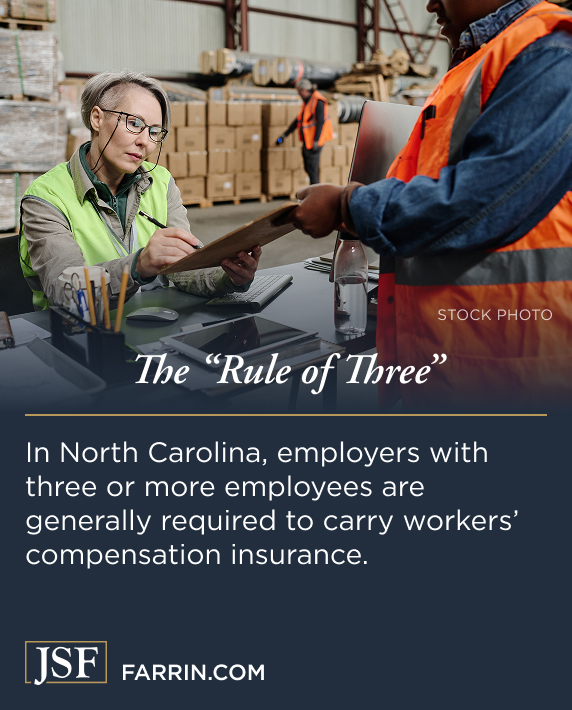 In North Carolina, the requirement for carrying workers’ compensation insurance is straightforward for most businesses. The rule is based on the number of employees. According to the North Carolina Workers’ Compensation Act, any employer that regularly employs three or more employees must generally obtain workers’ compensation insurance or qualify as a self-insured employer.
This “Rule of Three” applies to a wide range of business types, including corporations, sole proprietorships, limited liability companies (LLCs), and partnerships. It doesn’t matter if the employees are full-time, part-time, or seasonal. If the total number of people on the payroll at any given time reaches three, the requirement is typically triggered. For many people working in places like Charlotte’s financial sector or the manufacturing hubs around Greensboro, this rule means their employers almost certainly have coverage.
It’s also important to understand that corporate officers can count as employees. If a corporation has a president, a secretary, and a treasurer, they could be counted as three employees, thereby requiring the company to secure workers’ compensation coverage, even if there are no other workers.
Who Is Exempt From the Workers’ Comp Requirement?
While the “Rule of Three” covers most situations, state law includes some specific exemptions. Some common exceptions include:
- Certain Agricultural Employees: Farm laborers are often exempt if the employer has fewer than 10 full-time, non-seasonal farm laborers who are regularly employed.
- Domestic Employees: People employed directly in a private home, such as housekeepers or nannies, are generally not covered under the Act.
- “Casual” Employees: This refers to workers hired for work that is not part of the employer’s normal business. For example, if a law office hires someone for a one-time project to paint a single room, that painter might be considered a casual employee.
- Federal Government Employees: Employees of the U.S. government working in North Carolina are generally covered by a federal workers’ compensation system, not the state’s system.
- Railroad Employees: Certain railroad workers are also typically covered by a separate federal system.
These exceptions can create complex situations, and it is not always clear whether an employee falls into one of these categories.
Employee vs. Independent Contractor: A Critical Distinction
One of the most contested issues I see in my practice is the classification of workers. Many companies try to classify their workers as “independent contractors” instead of “employees.”
Some might do this to avoid the costs associated with payroll taxes, unemployment insurance, and, of course, workers’ compensation insurance. However, simply calling someone an independent contractor does not make it so in the eyes of the law.
The North Carolina Industrial Commission — the state agency that administers workers’ comp claims — looks at several factors to determine a worker’s true status. No single factor decides the issue; instead, the Commission looks at the total working relationship.
Here are some of the factors they often consider:
- Control over the work: Does the employer control how the work is done, or just the final result? An employee is typically told when, where, and how to perform their job. A contractor generally uses their own methods.
- Method of payment: Is the worker paid a salary or an hourly wage (like an employee), or are they paid a flat fee for a specific project (like a contractor)?
- Providing tools and equipment: Does the employer furnish the necessary tools, materials, and a place to work? Employees typically use company equipment, while contractors often bring their own.
- Ability to be fired: An employer can generally fire an employee at any time. The relationship with a contractor is usually governed by a contract and cannot necessarily be terminated without breaching that agreement.
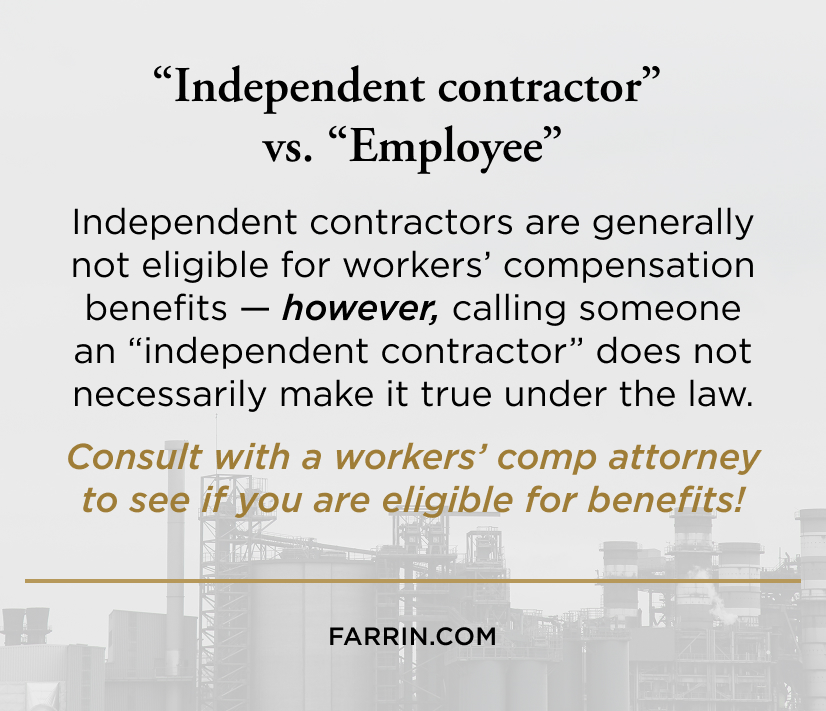
If you were told you are an independent contractor but your work situation looks more like that of an employee, you might still be eligible for workers’ compensation benefits if you are injured.
What Happens if a Required Employer Fails to Have Insurance?
When an employer who is required to have workers’ compensation insurance fails to do so, it creates serious problems for everyone involved. The state takes this obligation very seriously.
For the employer, the consequences can be severe. The North Carolina Industrial Commission (NCIC) has the authority to impose significant financial penalties for every day the employer is without coverage. Willful failure to carry required insurance is also generally a misdemeanor, and in some cases, it can even be a felony.
For the injured employee, the situation is more complicated but not without hope. An injured worker in this scenario has a choice.
- File a claim with the Industrial Commission: The worker can still file a workers’ compensation claim. If the claim is approved, the uninsured employer is personally responsible for paying the benefits. If they cannot pay, the employee might be able to receive payment from North Carolina’s Uninsured Employers Fund.
- File a civil lawsuit: The injured employee also has the right to file a personal injury lawsuit against the employer in civil court. In a normal workers’ comp case, you cannot sue your employer for negligence. But when the employer has illegally failed to provide insurance, that protection is removed. In a lawsuit, the employee can pursue not only medical bills and lost wages but also other forms of compensation, which might not be available in a standard workers’ comp claim.
Choosing the right path forward in this situation involves legal strategy and a careful evaluation of the specific circumstances of your case.
What Kind of Benefits Does Workers’ Compensation Provide?
Understanding why the insurance requirement exists is easier when you see what benefits it generally provides. The workers’ compensation system was designed as a compromise. Employees gave up the right to sue their employers for most workplace injuries, and in return, they received a no-fault system that generally provides specific, defined benefits.
“No-fault” means you do not have to prove your employer did something wrong to cause your injury; you generally only need to show that the injury happened at work and in the course of your duties.
The main potential benefits provided by workers’ compensation in North Carolina include:
- Medical Compensation: This can cover all necessary medical treatment related to the workplace injury. This can include doctor visits, hospital stays, prescription medications, physical therapy, and any required medical equipment.
- Wage Replacement Benefits: If your injury causes you to miss more than seven consecutive days of work, you might be eligible to receive a portion of your lost wages. These benefits are typically calculated as two-thirds of your average weekly wage, up to a maximum amount set by state law.
- Permanent Partial Disability (PPD) Benefits: If your injury results in a permanent impairment to a specific body part (like a hand, arm, or your back), you might receive compensation based on an impairment rating assigned by a doctor.
How to Check if an Employer Has Coverage
If you are unsure whether your employer has workers’ compensation insurance, you don’t have to guess. The NCIC provides a tool that allows you to look up an employer’s insurance coverage information.
This database can be a valuable starting point. However, sometimes the information might not be up to date, or the company might be listed under a different legal name. If you are having trouble finding information or if the system shows no coverage, it does not automatically mean the employer is breaking the law — they could be self-insured or fall under an exemption. However, it is a sign that you might need to look deeper into the situation.
The Role of an Attorney in a Workers’ Comp Case
Even in a no-fault system, getting the benefits you might be owed is not always simple. Insurance companies are businesses, and they often look for ways to deny claims or reduce the amount they have to pay. An attorney can help level the playing field.
From my perspective, an attorney’s job is to protect your rights and fight for your best interests. This may involve many different tasks, such as:
- Investigating the claim: We may gather medical records, accident reports, and witness statements to build a compelling case.
- Handling communications: We communicate with the insurance company, so you can focus on your health and recovery.
- Fighting a denial: If your claim is denied, we can represent you in the appeals process, including mediations and hearings before the Industrial Commission.
- Addressing disputes: We can address disputes over medical treatment, your disability status, or whether you are cleared to return to work.
- Fighting to maximize your compensation: We work to identify all benefits you might be owed and fight to get you the highest potential settlement or award as applicable.
FAQs for Is Workers’ Compensation Insurance Required in North Carolina
Here are answers to some common questions we hear regarding workers’ compensation insurance requirements in NC.
 Text Us